On a Pittsburgh radio show recently, the host, Sam Reich, asked Frank Coonelly, the Pirates’ president, why Gregory Polanco hadn’t been promoted to the major leagues, considering that he was tearing up the International League with his bat and the Pirates’ bats were anemic.
“The official line,” Reich told me Friday, “is it’s not a matter of finances; it’s a matter of experience and development. Huntington said pretty much the same line.”
Neal Huntington is the Pirates’ general manager, and it’s not surprising that the general manager and the president would spout the same party line. I tried, with multiple calls to each, to contact both Coonelly and Huntington, for comment on that party line, but neither returned the calls. So let’s explore the Pirates’ party line on our own.
This exploration takes place at an appropriate time, when clubs begin bringing up their good young players from the minor leagues. The promotion migration occurs every season around this time, with an influx of prospects who have been kept in the minors while the parent teams are manipulating their service time and delaying their eligibility for salary arbitration and free agency.
Let’s begin our scrutiny with this list of Pirates and the dates they were summoned to the majors:
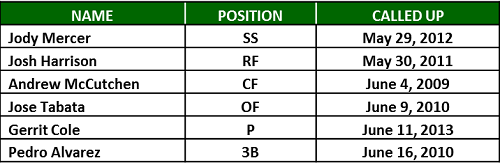
It is a remarkable coincidence that these half-dozen players gained enough experience and met the Pirates’ development requirement in time to be called up in the same three-week period in five different seasons. The Pirates have established a pattern that suggests that Polanco will arrive at beautiful PNC Park in the next couple of weeks. What better evidence could we have?
The Pirates and their players, though, are not unique. Consider these players from other teams and their call-up dates from 2007 to this year:
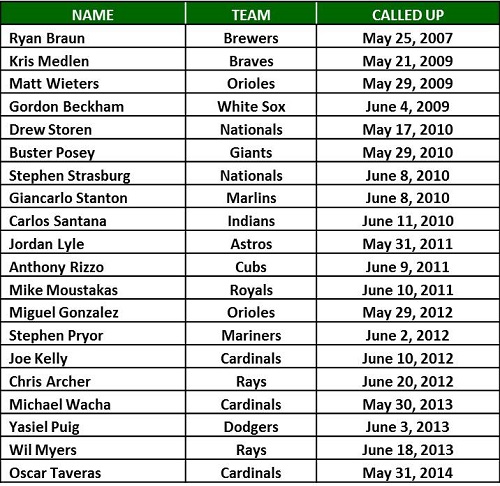
The Cardinals called up Taveras Saturday only because of an injury to first baseman Matt Adams. The rookie instantly demonstrated his value. Starting at first base Saturday night against the Giants, he hit a home run in the Cardinals’ 2-0 victory.
The Cardinals would very likely have made that move anyway because the 21-year-old Dominican was obviously ready, but this was most likely a couple of weeks earlier than they would have preferred.
The Cardinals, however, couldn’t help but rave about Taveras in their news release announcing his promotion. He was, they said, leading Class AAA Memphis in hitting with a .325 batting average, had driven in 40 runs in 49 games and was hitting .479 with runners in scoring position.
In addition, the Cardinals said, Baseball America rated Taveras their top prospect each of the past two seasons. What the release didn’t say was why they hadn’t called him up earlier. I suspect he needed additional experience and development.
That line is the one Coonelly and his fellow management lawyers wrote when he was in the commissioner’s office. All of the clubs use it: This player (fill in the name) needs more experience and development before we can call him up to play in the majors.
The clubs are so arrogant they expect everyone to swallow that line. They think that no one notices that all of these delayed players reach the acceptable intersection of experience and development around the same time.
Unfortunately for the players, there apparently is nothing illegal about the practice. The clubs, though, must have trouble accepting that because they lie about the reason for the delayed call-ups. Yes, I am saying Coonelly is lying when he says the reason Polanco remains in the minors is he needs more experience and development. If the Pirates were trying to turn the good-hitting, good-fielding outfielder into a ballet dancer, maybe he would need more lessons, but baseball is his game and he plays it extremely well.
In the latest International League statistics, Polanco was leading the league with a .348 batting average, 45 r.b.i. in 53 games and .556 slugging and .411 on-base percentages. He was tied for the lead in home runs with 6 and also had 15 doubles and 5 triples.
That Coonelly, when talking about Polanco, can say “experience and development” with a straight face is a testament to his acting ability. If in their place he said salary arbitration and free agency he would get higher grades for honesty and candor.
But most club officials can’t bring themselves to admit that money is the reason they deprive their fans of the Puigs and Polancos.
The union constantly scrutinizes the call-ups and waits patiently before filing a grievance, challenging the clubs’ practice. “It’s legal but questionable,” a labor lawyer said.
“We’re watching it,” David Prouty, the union’s general counsel, said. “We’re aware of several cases and we’re weighing our options.”
The clubs say an arbitration decision gives them the right to decide when to call up players. “I know they think that,” Prouty said. But Dan Halem, MLB’s executive vice president for labor relations, acknowledged that “we’ve never had a head-on case where the issue was ‘you delayed in bringing me up to affect my service time.’”
Halem said he would have his office look into the basis for the clubs’ stance, but no one from the labor relations department called before the weekend with information.
Prouty said he believed the clubs based their position on a 1986 case in which Dennis Lamp, a Toronto relief pitcher, filed a grievance against the Blue Jays, contending they stopped using him in September to avoid having a 1987 salary become guaranteed. The arbitrator, George Nicolau, ruled for the Blue Jays.
“The arbitrator said he wasn’t going to presume to tell a manager when to use a player,” Prouty said. The clubs apparently translate that position into being allowed to make decisions on the use of players, including when they can call up players.
One element of delayed call-ups that clubs don’t discuss is the integrity of the game. Fans expect teams to do their best to win, and if they are leaving players in the minors who might help them win they are undermining their integrity.
The timing of a player’s call-up is important because it triggers his service-time clock. Major league service time determines a player’s eligibility for free agency (six years needed) and salary arbitration (two years or “super two” status).
A season is 183 days, but a player needs only 172 days for a year of service time. Thus, if a player is called up more than 11 days into a season, he loses that year for a full season and has to play seven seasons before he can be a free agent.
But the bigger problem for a player is salary arbitration. Initially, a player was eligible for salary arbitration if he had two years in the majors. Then, in a concession to the clubs, the union agreed to raise it to three years.
That change didn’t sit well with the union’s younger members so the union negotiated a “super two” status. The top 17 percent of players with service between two and three years would be eligible. Last year the size of that group changed to 22 percent.
The “super two” element triggered service-time manipulation as clubs did what they could to avoid having their two-to-three-year players be eligible for arbitration. If a player is a “super two,” his salary escalation begins earlier and can cost his club millions of dollars until he signs a multi-year contract or becomes a free agent.
When the size of the “super two” group was 17 percent, its eligibility level of service time was two years and days numbering from the low 140s to the high 130s. With the change to 22 percent last year, the lowest eligible “super two” had two years and 139 days. This year the lowest eligible player had two years and 122 days.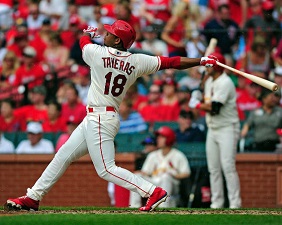
That drop meant clubs were going even later into the season before bringing up players from the minors. Using Taveras as an example, if he stays in the majors the rest of this season and all of the next two seasons, he will reach the end of the 2016 season with two years and 121 days.
Polanco will have less service time because he has yet to be called up.
Interestingly, perhaps surprisingly, many Pirates fans have not clamored for the team to change its practice. Some would rather see the Pirates hold onto a player for an extra year before free agency rather than have him come up a month or two earlier in his rookie season.
I asked a Pittsburgh lawyer whom I know and who is a big Pirates fan for his thoughts on the matter.
“I would say the feelings of Pirate fans on this subject are mixed,” Ken Haber wrote in an e-mail. “People are frustrated knowing the Pirates have perhaps their second best player still in the minors, but I think some fans (me included) have come to accept (or have been brainwashed) that this tactic is a necessary way of trying to compete with the larger market teams. I haven’t taken a poll, but I’d bet that about half of the fan base believe this practice of keeping stars in the minors until June is a necessary evil for the Pirates.”
Another reader of the column, who is a Pirates fan, had mixed feelings.
Terrence Valko said he’d like to see Polanco in a Pittsburgh uniform now. “He is said to be better than Dave Parker,” he wrote.“But Aramis Ramirez and Jose Guillen were rushed. Tabata was rushed. McCutcheon was ‘just right’ in minor league seasoning. I understand the Super 2 issue and don’t mind waiting a couple months to gain a year of duration.”
He also credited “Coondog and Nigel (Neal Huntington) with being the, ‘best front office in Sport.’”
Sam Reich, a Pittsburgh lawyer, on whose radio show Coonelly talked about Polanco needing experience and development, didn’t go that far in his assessment of the Pirates but said, “Frank is an asset in the community.”
The Pirates are not the only team with good young prospects who are awaiting promotions to the majors. These players could join the June jaunt:
Infielder Maikel Franco, Phillies; pitcher Jonathan Gray, Rockies; pitcher Andrew Heaney, Marlins; first baseman Jonathan Singleton, Astros, and outfielder Joc Pederson, Dodgers, who have many good and high-priced outfielders ahead of him.
One of those outfielders is Yasiel Puig, the irrepressible Cuban, whom the Dodgers belatedly promoted last June 3 and then watched as he ignited the Dodgers out of their doldrums and catapulted them into the post-season. Better late than never, right?
Are the Pirates ignoring that possibility for Polanco and themselves? I guess we’ll never know.