The American League’s three division leaders met for a series of round-robin games over the last two weeks, with Oakland, Detroit, and Toronto looking to establish early-season supremacy in the Junior Circuit. The Athletics and Tigers split a four-game series in Detroit, and it has been the surprise division leader—the Blue Jays—sweeping the potential playoff previews.
League-leading Oakland was up first. The A’s flew to Toronto in late May having won 11 of 13 games in the previous two weeks, generating a healthy amount of “Moneyball 2.0” buzz along the way. In the second inning of the series, Toronto’s fill-in second baseman, journeyman Steven Tolleson, jumped on a 3-1 Scott Kazmir offering for a two-run home run, his first of the year, and the Blue Jays never trailed in the game. Tolleson had hit just three career homers entering this season, but Toronto’s early-season home run binge is affecting all members of the lineup.
Evidence came the next day, when infielder Brett Lawrie, whose career high in home runs entering 2014 was just 11, hit his eighth of the year to break a 1-1 tie; again, Toronto never trailed after its home run en route to another victory over Oakland. To round out the sweep the Blue Jays relied on another homer, with first baseman Edwin Encarnacion blasting his 14th home run of the year to open the scoring and, once again, give the home team a lead it wouldn’t relinquish. Encarnacion added two more homers in May, giving him 16 for the month to tie an American League record.
The Jays weren’t done. In Detroit this week, Toronto has continued homering and winning in the same breath. Lawrie slugged his ninth of the year, a three-run blast, in a two-run win Tuesday night, and Melky Cabrera matched Lawrie with his ninth to give Toronto the lead Wednesday before Detroit had the chance to bat.
The Red Sox are the defending World Series champions. The Rays have won 90-plus games in four straight years. The Yankees spent the winter revamping their roster with a nearly-$500 million spending spree. The Orioles boast a lineup with five All-Stars. Those four teams each won at least 85 games last year, and they all received multiple votes to win the division in ESPN’s 2014 preseason preview.
Of the 44 ESPN staffers who made preseason predictions, though, not a single one picked the Blue Jays to win the AL East, and only one selected Toronto as a wild-card team. Maybe they were scared off after 2013, when 20 members of ESPN’s team forecast the Blue Jays as the division champion only to see Toronto flounder to 74 wins and a last-place finish.
It has been a lean two decades for Toronto baseball since the team won consecutive World Series titles in 1992 and 1993. The Blue Jays haven’t qualified for the playoffs or won 90 games in a season since, and only in 2006 did they even finish in second place in their competitive division. Heading into 2014, they had gone six straight years finishing in fourth or fifth place.
But after compiling a league-leading 21-9 mark this May—tied for the most wins in a month in franchise history—the Blue Jays sit a comfortable 4.5 games clear of second place. Toronto’s 34-24 record after two months was the team’s best since 1993, a season that ended with Joe Carter touching ’em all.
Fitting when reminiscing about Joe Carter, the most-discussed stat for the Blue Jays’ offense has been its home run output. Toronto’s 83 home runs lead the league by a wide margin, and both Encarnacion (19) and Jose Bautista (14) rank in the top 10 in the majors. Nine players in the AL East have blasted eight or more home runs this year, and six play for Toronto; no other AL team has more than three players with as many homers.
The Jays’ offense is simply one of the best in baseball, particularly with regard to power numbers. Of the team’s nine players with at least 100 plate appearances, eight are slugging .400 or better (the AL average is .394). Not only does the team lead the league in home runs but it ranks first or second in total runs, hits, on-base percentage, and slugging percentage.
After the team’s disappointment a year ago following its offseason trading bonanza, there’s reason for excitement in the Rogers Centre. Coupled with inconsistent starts for Toronto’s division opponents—or, in the case of Tampa Bay, a consistently awful start—fans have to be optimistic about the team’s chances for bringing postseason baseball to Canada for the first time in 21 years.
Accompanying this optimism in several corners of the Internet is another fact: four of the last six teams to have led the league in home runs have won their respective divisions. This argument seemed specious at first, a flukish streak and the product of small sample size. After all, I started watching baseball during the height of the Steroid Era, when balls flew into the stratosphere above Arlington and Denver only for those homer-happy home teams to miss the playoffs. Does hitting more home runs really correlate with playoff appearances?
Since the expansion to three divisions and the addition of the original wild card, the answer to that query is decidedly mixed. While the fact that spurred my research is correct—four of the past six teams to lead the league have indeed won their divisions—it’s a bit misleading. One of those teams, the 2008 White Sox, were hardly a juggernaut, winning just 88 games in a weak division and requiring a tiebreaker victory over the Twins to advance to the postseason. The other three were all Yankees, with the 2009, 2011, and 2012 versions of the Bronx Bombers living up to their moniker and leading the league in both home runs and the AL East in wins.
Before 2008, though, teams that won the home run title fared much worse in the standings. The last non-Yankee team to win its division outright while also leading the league in home runs was the 1997 Seattle Mariners—or about 600 homers, one-season-long suspension, and $350 million ago for Alex Rodriguez, that Seattle squad’s young shortstop. It has been nearly two decades since a non-Yankee team led the league in homers and won more than 90 games (the 1995 Cleveland Indians).
In fact, taking into consideration only the non-Yankee home run leaders in that time yields a rather unimpressive result: an average record of 81-81, with just two division winners among 15 teams. From 1998-2003, it was particularly bad: no team that led the league in home runs managed even a .500 record or finished within 10 games of the division winner.
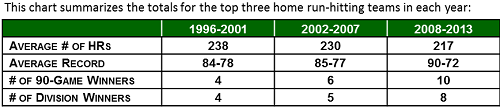
My initial suspicions were correct, then: the recent trend appears to be nothing more than small sample size. But there’s another way to tell this story, and that comes when we expand the calculations a bit. Instead of focusing on just the leader, let’s take a look at the top three home run hitting teams per year. When we do, a more concrete pattern starts to emerge.
In the six-year stretch from 1996-2001, only four of the 18 teams that finished in the top three in home runs in a year won 90 games, and only four won their division. Homer-happy teams fared a little better from 2002-2007, with six winning 90 games and five winning the division.
The jump in success started six years ago; since 2008, more than half of the teams to finish top 3 in homers won 90 games, and eight won their division. And only last year’s Mariners, who improbably ranked second in home runs despite winning only 71 games, have performed so well in the home run rankings and finished with a losing record.
The explanation for these findings is quite murky. The first suggestion that jumps out is that with home runs down league-wide since the end of the Steroid Era, teams that still have power bats throughout the lineup should stand out more from their competition. But there is no noticeable or consistent trend in the difference between the number of home runs hit by the top team (or top three teams) and the MLB team average in any given year. Rather, as the average has generally trended negatively in the last decade, so has the average for the home run leaders. Splitting the past 18 years into those same six-season segments, the average for the top three home-run hitting teams has decreased from 238 (1996-2001) to 230 (2002-07) to just 217 (2008-13).
There have been outliers every few years, of course—teams that performed far better than average—but even those high-scoring outfits struggled in the standings: the highest single-season home run totals since the turn of the century belong to the 2005 Rangers (260), 2010 Blue Jays (257), and 2000 Astros (249), all of whom missed the playoffs.
Perhaps the explanation is that home runs can act simply as a stand-in for total runs, but this logic does not hold up either. Since 1996, teams that have finished in the top three in home runs in a year have consistently ranked an average of sixth in total runs; in other words, there is no indication that hitting more home runs correlates with higher run production now that homers—and overall runs—are declining.
The explanation might elude discovery, but the trend itself—that in the last six years, teams that perform better in the home run rankings have performed better in the win-loss ledger—only appears when examining the numbers through a very specific set of parameters. We simply need more data to arrive at firmer conclusions, so any writer jumping to cite the Jays as likely division winners because of the last six seasons should hold off on making any such proclamation.
Even this year, the results are mixed: of the top home run-hitting teams, the Blue Jays, A’s, and Giants are all division leaders whereas the Rockies (second in home runs) started strong but have fallen back below .500 in winning just two of their last 10 games.
If there’s any lesson to be taken from the last 18 years of data, it is that continuing to lead the league in home runs will be a byproduct, not a cause or marker, of Toronto’s offensive prowess. So, Blue Jays fans, don’t grow too excited that your team is leading the league in home runs, lest it repeat its 2010 result. That year, the Blue Jays hit 103 more home runs than the average MLB team—the highest difference in the last two decades—but finished just 85-77, 11 games back in a distant fourth place. This year, at least 85 wins might be enough to take the AL East crown.
Or teams should just try to emulate the 2000s-era Yankees for regular-season success. That would probably work, too.