With a decision imminent or sooner, a would-be bettor was unable to get odds last week on which way the United States Supreme Court would rule on a New Jersey appeal of a 2016 appellate court decision that kept legal sports betting confined to Nevada.
The high court does not announce in advance its schedule of rulings in this session, which lasts into June. But the legal betting case has generated tremendous interest, and the court could take that interest into consideration and issue its ruling earlier in the term rather than later.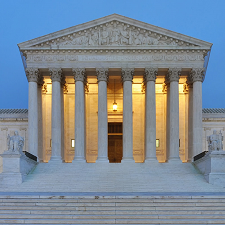
Citizen gamblers are not the only ones who have eagerly awaited the Court’s decision. Nearly two dozen state legislatures have been working on bills that would enable bettors to place wagers on games of Major League Baseball, the National Basketball Association, the National Football League, the National Hockey League and the National Collegiate Athletic Association.
That group serves as the ironic element of the saga known as PASPA – the Profession and Amateur Sports Protection Act. PASPA and former New Jersey Gov. Chris Christie have been in courts for years as opponents, but now the five sports leagues and organizations support the same result as Christie and the state of New Jersey.
Not long ago all five of these organizations opposed legalized gambling, primarily on integrity grounds. More recently, though, they have seen the light, that is, the billions of dollars that are available through betting and declared “Damn the integrity, full speed ahead.”
Now it seems that they can’t get that untapped revenue soon enough. At least two of the leagues – MLB and NBA – have sent lobbyists into states that are debating sports betting bills.
The NBA was the first and has been the most aggressive league in the pursuit of legal betting and was the first to set a price on its cooperation, telling a New York state senate committee in January that it would want 1 percent of money wagered on NBA games. MLB soon followed, advising a West Virginia state senate committee it, too, wanted a 1 percent integrity fee.
Before having a lawyer appear at the West Virginia hearing, MLB had been silent on the subject of legal sports betting. At the West Virginia hearing, however, MLB’s lobbyist echoed the NBA’s 1 percent integrity fee. It turned out that 1 percent wasn’t 1 percent but more like 20 percent.
Brett Smiley, editor-in-chief of SportsHandle.com, explained it this way:
“Some people who are new to the sports betting industry confuse handle for revenue. Handle is the total amount wagered by bettors, so it’s a gauge of how much money is flowing through sportsbooks. Revenue, on the other hand, is how much sportsbooks hold from the total amount wagered. Historically, this number comes in at about five percent of handle for sportsbook operators.
“An integrity fee of one percent, then, would send that amount of wagers from the sportsbooks to the leagues, regardless of the revenue picture of the sportsbook. Using a baseline of five percent hold, a one percent integrity fee would equate to roughly 20 percent of revenue going to the leagues.”
If nothing else, the difference between 1 percent and 20 percent explains why sportsbooks might balk at the leagues’ demand for 1 percent.
“I don’t see why we should give you 1% for anything,” Smiley quoted a West Virginia state senator as saying to MLB’s lobbyist. “Why should we pay you to protect you own interests? Especially 1% off the top. It’s like we’re paying the insurance premium on your game.”
As the weekend approached, the West Virginia legislature was on the verge of passing a bill allowing sports betting in the state if the Supreme Court overturned the law New Jersey is fighting. MLB seemed to be in conflict. It supports legal sports betting, but Commissioner Rob Manfred told West Virginia reporters last Friday that MLB would urge West Virginia Gov. Jim Justice to veto the bill if provisions recognizing sports leagues’ interests were not put in place.
West Virginia obviously wants to be prepared to act instantly if the Supreme Court overthrows the 1992 law that New Jersey has fought, wanting its casinos and race tracks to have the same gambling right as Nevada’s establishments have.
League lobbyists have been very active in pursuing plans for post-Court decision. According to SportsHandle.com, they have provided state legislators in multiple states with a “Model Sports Wagering Act.”
Included are (a) The right to “restrict or limit wagering on a sporting event” after providing notice; (b) The right to impose “restrictions on the sources of data and associated video upon which an operator may rely in paying wagers;” (c) The right to restrict the types of bets that may be offered; (d) The right to collect real-time information on operators’ wagers; and (e) The 1% “integrity fee” remitted at least once per quarter.
There is plenty there that would stir disputes, but whatever differences exist between the leagues and the gambling industry, they will be resolved. Too much money is involved for everyone for an agreement to be unattainable.
The gambling industry gains because more bettors will gamble legally. The leagues and teams will benefit by receiving shares of that untapped revenue, money they would otherwise not have.
Team owners have already seen the future. Jeffrey Loria sold the Miami Marlins for $1.2 billion, a ridiculously steep price for a team that was one of the most poorly run in professional sports. A Loria lawyer confirmed that Loria based his asking price on the new owner economics.
In the NBA around the same time, the Houston Rockets sold for $2.2 billion and a 49 percent share of the Brooklyn Nets was sold for a price that put the Nets’ value at $2.3 billion.
No one knows where legal sports betting will take the leagues and teams, and the players for that matter because the owners will have more money to pay higher salaries. A baseball official told me that all of the owners favored legal baseball betting even though they have been very quiet on the subject. Why is that, I asked the official.
“It’s ‘don’t count your chickens before they’re hatched,’” he said.
That’s a good point. The owners can’t spend that extra money before they know they have it, and they won’t know anything until the Supreme Court acts.
The court could go in one of different directions. It could uphold PASPA, leaving the leagues and the gambling industry with the status quo. It could overturn PASPA, ruling it unconstitutional and opening legal sports betting to any state that wants it.
It could also do neither and throw the issue in Congress’s lap. That ruling would provide a field day for lobbyists.
So are there odds on how the nine black-robed justices will rule? I returned to Brett Smiley for the answer. He sent me two links, where he said I could find odds. Unfortunately, the links’ pages no longer existed. Smiley offered some other type of odds, but not being a bettor myself, I found them too confusing and opted to wait for the ruling.
REVENUE-SHARING CHEATS MAYBE BUT NO COLLUSION
The Miami Marlins were caught as revenue-sharing cheats so obviously in 2010 that the commissioner ’s office didn’t even bother contesting the union grievance, instead joining the union in ordering them to use revenue-sharing proceeds the way the rules say – improve their team and don’t use the money for other purposes.
Under a different owner, the Marlins have been accused again of not using their revenue-sharing funds appropriately. This time the union also brought similar charges against the Rays, the A’s and the Pirates.
“We have received the complaint and believe it has no merit,” the commissioner’s office said in a statement.
The Players Association had no comment about its grievance, but executive director Tony Clark, in the Pirates’ camp for the annual spring meeting, said, “We wouldn’t file a grievance unless we had serious concerns.”
The Marlins are the most likely of the four teams to be found guilty by an arbitrator. They are No. 1 on the revenue-sharing list, receiving more than $60 million, in addition to getting $50 million from the Central Fund. Yet this off-season they traded Giancarlo Stanton, Dee Gordon, Christian Yelich and Marcell Ozuna , all standout members of the Marlins’ starting lineup last year.
The Rays, who received about $60 million in revenue sharing, traded Evan Longoria, Steve Souza Jr., Corey Dickinson and Jake Odorizzi.
The grievance is a pretty good indication that the union doesn’t plan to file a grievance accusing the clubs of collusion. Ninety free agents were unsigned when spring training began, but the union apparently didn’t find enough obvious evidence to establish that the clubs acted in concert by not signing free agents.