The third time is supposed to be a charm, but this is the fourth time I am presenting this proposal and I have little, if any, confidence in its chance of being successful.
I initially made the proposal in May 2001, then again in November 2005 and a third time in October 2010. Bud Selig was the commissioner during that entire period, and I suppose the plan was too radical for him, even though he gave me the idea for my proposal with his phony plan for contraction.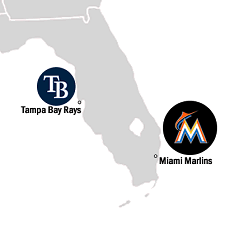
As it turned out, Selig didn’t really want to eliminate two teams; he just wanted to threaten to eliminate two teams as a negotiating ploy to frighten the players into making a labor agreement that would be more to the owners’ liking.
To make contraction appear possible, Selig had what looked a legitimate plan. Major League Baseball owned the Montreal Expos so that was one easily contractable team. The other was the Minnesota Twins, whose owner Carl Pohlad was close to Selig and was willing to let it be known that the Twins would agree to contraction.
The players, though, didn’t fall for Selig’s transparent trick and reached agreement on their terms. That was the negotiation and settlement that led to the long-lasting and prosperous peace the two sides have enjoyed.
I, on the other hand, pursued my proposal. If the owners wanted to shed two teams, I wrote, they could simply lop the state of Florida off the MLB map.
The Florida Marlins and the Tampa Bay Devil Rays, as the teams were then known, were two of MLB’s newest teams, and both immediately displayed fatal weaknesses.
H. Wayne Huizenga won the World Series in the Marlins’ fifth season and before the last pitch had been thrown was figuring out how to dismantle the team so he wouldn’t have to face a series of big players’ raises. He was a businessman, Huizenga told baseball associates, and was in the game to make money, not give it away.
The Devil Rays’ owner was Vince Naimoli, and he quickly showed himself to be a disaster. He was clearly the worst owner in the new century.
Shed the Devil Rays and the Marlins, I suggested, and there’s your two-team contraction.
Those extra teams, though, were critical to the owners’ economic well-being because two arbitrators had found the owners guilty of collusion and ordered them to pay the union $280 million in settlement of three grievances.
So the owners never contracted and the older owners sat back and took the new owners’ money and paid off their collusion bills. The new owners, of course, weren’t around for collusion, but they paid anyway.
Near the end of 2005, MLB still had 30 teams; none had been contracted. However, the Marlins, under their third owner, Jeffrey Loria, were undergoing their third demolishment as yet another owner didn’t want to pay players for winning.
In Tampa, the new owner, Stu Sternberg, was having similar payroll problems, and again I suggested that MLB would be better off without Florida on its map. But again no one listened.
Both owners spent most of their time looking, not listening. Both desperately needed new parks if they were to succeed in south Florida. The Marlins’ lease was running out in Miami, and the Rays were playing in a park not fit for a major league team.
Despite a third-class playground, the Ray reached the post-season four times, ending their visits with losses, including the 2008 World Series against Philadelphia.
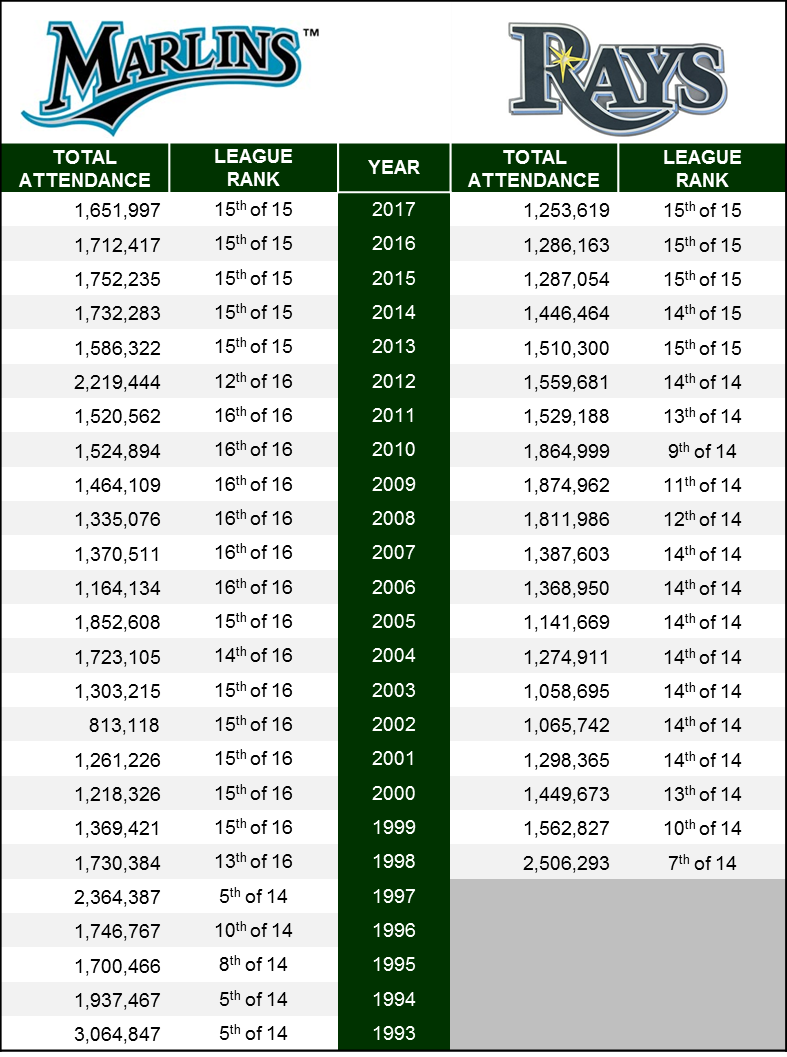
The Marlins, meanwhile, got themselves a new ball park, but they have squandered their presence in it. The have had six losing seasons in their six years there, and they have had the National League’s lowest attendance in each of the last five seasons.
The Rays have had the American League’s lowest attendance in each of five of the last six seasons.
Florida obviously wasn’t intended to be a major league state, but the owners, hungry for expansion money, ignored that problem. They ignored two other warnings as well.
When it became apparent that the owners were going to put an expansion team on the west coast of Florida, then Commissioner Peter Ueberroth cautioned prospective recipients not to begin building a park without first being awarded the team.
A flock of owners of existing teams also expressed the view privately that it would be a mistake to put the team in St. Petersburg. The prevailing private view was to build a park and put the team in the Interstate 4 area between Tampa and Orlando. In retrospect, that seems to have been a better idea.
All these many years later, the Rays seem to have done just that by recently selecting a site northeast of downtown Tampa called Ybor City. You can get there by taking exit 1 of I-4. However, don’t plan to see a game there too soon.
The Rays said the site has been No. 1 on their list for about six months, but they have signed no papers, negotiated any leases or begun any work. In other words, it will be a while before anyone plays a game in Ybor City.
Maybe there’s still time to adopt my plan, which I think would have been better. Lop off the Marlins and the Rays and wait for other sites to emerge, maybe Las Vegas for one. No one wanted to put a third team in the metropolitan New York area, but Brooklyn and northern New Jersey would be better than Miami and Ybor City.
UNION WATCHING CAREFULLY
With nearly 50 free agents still unsigned, there’s been rampant speculation that the union will likely file a grievance against the owners accusing them of collusion. If there’s going to be any kind of grievance, though, I think it will be more likely against teams for not using their revenue-sharing funds appropriately.
The Marlins were nailed as revenue-sharing cheats in 2010, and their violation of the basic agreement was so stunning that the commissioner’s office agreed with the union and didn’t challenge the grievance.
The union’s focus this off-season has been primarily on the Marlins, the Rays and the Pirates (whom the union also scrutinized in 2010) because of their trades of their highest-paid players.
The Marlins have traded Giancarlo Stanton, Dee Gordon, Christian Yelich and Marcell Ozuna, the Pirates Andrew McCutchen and Gerrit Cole and the Rays Evan Longoria, Corey Dickenson, Steve Souza Jr. and Jake Odorizzi.
The Marlins received the largest revenue-sharing payment for last year, an amount just above $60 million, while the Rays received $60 million. A club executive said they were the biggest beneficiaries.