Who invited the Cleveland Indians to the post-season party?
Apparently no one. It seems that the Indians are just a band of party crashers, barging through the door when no one was looking.
Three games from the second wild-card spot at the All-Star break, the Indians unexpectedly and stubbornly clung close the rest of the season until they snatched the second spot from Texas Sept. 20 and dislodged Tampa Bay from the top spot Saturday.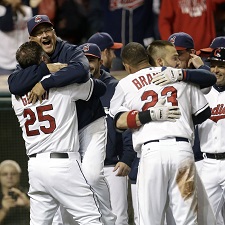
A 10th straight victory Sunday enabled them to avoid a three-team wild-card playoff for the two wild-card spots and gave them a 92-70 record, only a game behind American League Central champion Detroit.
But the Indians’ furious finish created the possibility of another intriguing development – having four of the 10 teams with the lowest payrolls make the playoffs in the same season.
When the regular season ended Sunday, Pittsburgh (27th), Oakland (26th) and Cleveland (21st) had qualified for the post-season. To join them, Tampa Bay (28th) had to win Monday’s one-game playoff for the playoffs.
The playoffs have never included teams with four of the bottom 10 payrolls. The only year before this one with three was 2007 when Colorado (26th), Arizona (23rd) and Cleveland (22nd) made it. All three teams made it to the league championship series, with Cleveland losing to Boston and Colorado beating Arizona before losing to Boston in the World Series.
For the now resurgent Indians, the 2007 season, like this one, was part of their austerity period. From 1996 through 2002, when revenue flowed from nightly sellouts at Jacobs Field, the Indians were among the top 10 payrolls.
The rain of revenue, however, abated, and the payroll has languished in the bottom third since.
This year’s team is a collection of players acquired by general manager Chris Antonetti from all points of the baseball globe.
Acquired in trades or signed as one sort of free agent or another were first baseman Nick Swisher, shortstop Asdrubal Cabrera, outfielders Michael Brantley, Michael Bourn and Drew Stubbs, designated hitter Jason Giambi and productive backups Yan Gomes and Ryan Raburn.
Club president Mark Shapiro was particularly high on Raburn, who was signed as a minor league free agent, and Gomes, who was obtained from Toronto in a trade last November.
“Gomes has been the best all-around player in the second half, hitting and throwing guys out,” Shapiro said of Gomes, who has split catching time with Santana. “Guys love him. He’s been in the lineup every day. Raburn came in as a non-roster player and every day he’s in the lineup.”
The Indians’ starting pitching rotation is even more alien to the organization than the everyday lineup. Ubaldo Jimenez, Justin Masterson, Zack McAllister and Corey Kluber came in trades, and Scott Kazmir was signed as a free agent.
Masterson missed some time in September with a strained muscle but returned and pitched in relief the last week. His 14-10 record was the best among Cleveland starters this season.
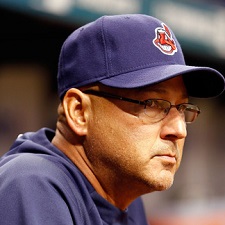 One other member new to the Indians has stood out, and Shapiro couldn’t say enough about manager Terry Francona, who worked in the Indians’ front office before managing Boston to a pair of World Series championships.
“I can’t imagine anybody doing a better job,” Shapiro said. “I’ve known him for 15 years and his managing is amazing. How hard he works, his relationship with players; those things I knew. But a guy with a sense of urgency and intense competitiveness; that’s a very rare combination. And there’s his respect for players and for the game.”
Francona is part of the most intriguing possibility for the post-season. A victory in the wild-card game would put the Indians in a division-series with the Red Sox, who fired Francona, unjustly, I believe, after the 2011 season.
The Red Sox, of course, are not among the low-payroll teams. They are among the top 5 with a payroll just about double the Indians’ $82.5 million.
Shapiro said he liked the idea of having low-payroll teams in the post-season, but he advised against getting used to the novelty.
“It’s nice,” he said. “It’s going to happen. But because of our record we’re going to draft low and not have access to the best players.”
He cited teams like Pittsburgh, Baltimore and the players they have been able to draft in recent years because of their poor won-lost records.
“I caution that it means anything,” Shapiro said. “There’s some residual impact.”
He acknowledged, however, that the Rays “have avoided the downturn.” “They’ve made some good trades. But they’re going through the pains of trading guys before they become free agents.”
He mentioned Evan Longoria and David Price, whom the Rays selected in successive drafts with the third and first overall picks, respectively.
“They’re not going to be drafting guys like that any time soon,” he said.
I had planned on talking to Tampa Bay officials about this subject, but they haven’t returned my telephone calls or responded to e-mail requests for several years so I called Rick Vaughn, the Rays’ vice president for communications.
I told him I would like to speak to one of three men – Stu Sternberg, the owner; president Matt Silverman or general manager Andrew Friedman. He said he didn’t think any of them would speak to me, but he would ask and “get back to me.”
I never heard from any of the three or Vaughn, who didn’t get back to me.
Why don’t they speak to me? What terrible, dastardly, awful thing did I write about them? On the contrary, I have always written favorably about the Rays because I think they have a very good organization, one of the best, in fact.
It seems, however, that in their eyes I did write something bad about Friedman. In a 2009 column about manipulation of major league service time for players, I wrote that Friedman did not return a call. It’s a routine sentence that reporters are instructed by their editors to use to explain to readers why the article includes no comment from one of the subjects.
I have written that sentence hundreds of times over the many decades I have been writing. The Rays are the only ones to take offense. So here it is one more time: Rays’ officials did not return a call seeking comment on teams with low payrolls making the playoffs (even though one of them said he would get back to me).
MARLINS OVERCOME NO-HITTER RULES
As soon as Matt Tuiasosopo swung and missed, I called Fay Vincent and said, “This is your fault.”
“OK,” the former commissioner responded, “what is?”
“Henderson Alvarez hasn’t allowed a hit in nine inning against the Tigers,” I told him, “but he doesn’t have a no-hitter because of you and your committee.”
In September 1991, Vincent chaired a committee baseball pompously called the Committee for Statistical Accuracy, and it redefined no-hitter.
The new guidelines deleted previously designated no-hitters that had not gone nine or more innings and defined a no-hit game as “one in which a pitcher or pitchers complete a game of nine innings or more without allowing a hit.”
When Alvarez finished the top half of the ninth inning Sunday without having allowed a hit, he didn’t have a no-hitter because the game wasn’t over. The score was 0-0. However, the Marlins made his performance a no-hitter by scoring a run in their half of the ninth on a two-out bases-loaded wild pitch by Luke Putkonen.
According to Elias Sports Bureau, the Alvarez no-hitter was the first achieved in such a circumstance in more than half a century, since Virgil Trucks beat Washington, 1-0, on a Detroit run in the ninth inning. That game was the first of two 1-0 no-hitters Trucks threw that season (1952). The second came against the Yankees three months later.
HILL GETS TO BE KING OF THE HILL
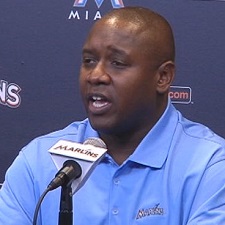 Several years ago, when I was tracking baseball’s hiring of minority general managers and managers, the Marlins named Michael Hill general manager and I added him to my list.
But then I was told Hill really wasn’t the general manager. He was given the title but not the duties or the authority. Larry Beinfest, who had been general manager, would retain the duties with the title president of baseball operations. Jeffrey Loria, the Marlins’ owner, had given Hill the title to discourage him from going elsewhere.
Now Loria has fired Beinfest and given Hill his job and his title.
But what about the authority? I wrote here recently that Loria, in reality, was his own general manager. I don’t expect that to change. Hill most likely knows it better than anyone.
A-ROD MEETS THE ARBITRATOR
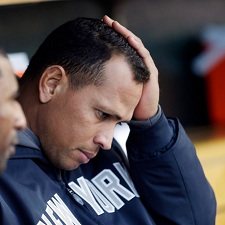 Alex Rodriguez, with a 211-game suspension in waiting, was scheduled to begin his fight for his baseball life Monday in a hearing before Frederic Horowitz, baseball’s impartial arbitrator.
Although I believe that the New York Yankees’ star slugger has a good case in his defense and a good chance to have the suspension drastically reduced, I also suspect that Rodriguez has made a serious mistake in planning to have his expensive legal team argue his case before Horowitz.
This is a case for union lawyers with grievance hearing experience, not for bombastic defense lawyers with little or no arbitration experience. Rodriguez will not get a do-over if he doesn’t like the outcome.
Ian Penny, I was told, is the union lawyer who will represent Rodriguez if A-Rod and his high-paid lawyers let him. No decision in the grievance is expected for weeks, if not a couple of months.
BYE, BYE BUD…OR MAYBE NOT
After Bud Selig assumed command of the commissioner’s office upon Fay Vincent’s resignation in September 1992, anyone who referred to Selig as interim or acting commissioner was told in no uncertain terms that he was not interim commissioner or acting commissioner, whichever title someone used. I cannot count the number of times I heard that denial.
However, in the news release last week announcing Selig’s plan to retire Jan. 24, 2015, it said:
“Selig has led Major League Baseball since September 9, 1992, when, as Chairman of the Major League Executive Council, he became interim Commissioner.”
The question arises: Has it been so long and Selig has become so old that he has forgotten his standard denials or was he just trying to fool us?”
Meanwhile, do not be surprised if sometime next year, Selig announces that the owners have prevailed upon him to stay on another year or two, and he has reluctantly agreed to their request.