If only Commissioner Bud Selig would be honest with baseball’s fans, its owners, executives and players and the news media but mostly with himself, he would acknowledge that he has played toesies with Fox television long enough, and now it’s time to be honest and go legitimate.
I’m talking about Selig’s silly idea of linking the All-Star game to homefield advantage in the World Series. You might have seen a mention or two about that idea in this space since it was implemented in 2003.
I bring it up again now because my idea for a replacement plan is based on a particular standing at the end of the season. A replacement plan is needed, I believe, because the All-Star link is a farce. The All-Star game is an exhibition game, a game totally unrelated to events of the season or post-season. I have never heard anyone say otherwise.
But through Wednesday, 297 games had been played that do mean something. They have been regular-season games that count in the standings, that count in the teams’ standings, games that help determine which teams will have a chance to play games that could take them to the World Series.
Hits that players get in those games, outs that pitchers secure could actually be meaningful in helping their teams attain their post-season quest.
With only a Tigers-Marlins weekend series remaining, the American League had already locked up this year’s interleague competition, the first in another new era, in which interleague games have been played virtually every day with 15 teams in each league.
A.L. teams had won 154 games, N.L. teams 143. This is the 10th successive season the A.L. has prevailed, meaning it would have been the 10th consecutive World Series the A.L. champion would have had homefield advantage.
But under the existing system, the A.L. won the first seven games and homefield advantage, and no one complained.
Some, including the commissioner, I believe, have argued that using something other than the All-Star game would create problems logistically, creating uncertainty about where games would be played.
That circumstance, however, exists now. The season is in its last week, and homefield advantage and division-opening cities haven’t been decided because of the uncertainty of final won-lost records. It could be done if the commissioner saw the wisdom in this or any other legitimate plan and said to his friends at Fox, “Hey, we gave it a good shot. It just hasn’t worked.”
I had planned on asking Selig what he thought about the interleague idea, but he didn’t return my call Wednesday. No loss, though. I’m pretty certain what he would have said.
On the David Letterman show in July, just before the All-Star game, Letterman brought up the All-Star game, which gave the commissioner an opportunity to sell his nonsense about the link between the game and homefield advantage in the World Series.
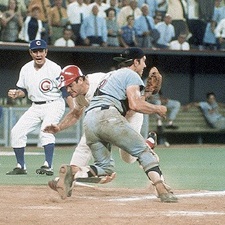 Letterman recalled the game in which Pete Rose scored the winning by flattening Ray Fosse at home plate.
“The All-Star game meant something in those days,” the commissioner said. “We’ve brought that back. The last five or six years the intensity of the All-Star game has been terrific because it does mean something.”
The man insults our intelligence. Intensity? Where was the intensity in this year’s game?
The American League won, 3-0, with two of the runs scoring on a sacrifice fly and a force play. Batters were retired in 1-2-3 order in 8 of the 18 half innings. Prince Fielder led off the A.L. ninth with a triple and remained at third as the next three batters made outs.
Last year was worse, with the N.L. scoring 5 runs in the first inning and winning, 8-0. Not much intensity there.
When he created the World Series link, Selig wasn’t seeking intensity. He was seeking higher ratings for Fox television and hoped the link would create a smokescreen that would fool the fans into thinking there was something important happening. Has it helped?
The year before the link Fox found that the 2002 game’s viewership was 14,653,000. In the 11 years of the link the viewership has not reached that level, coming close only three times and plunging as low as 10,897,000 in 2012. The game averaged 10,956,000 this year.
A misguided friend of mine defends the link, saying without it Fox might not get the number of viewers it has had. Even if that’s true, it’s no excuse to concoct and continue such a gimmick.
Selig and Major League Baseball have done more than enough to try to enhance interest in the All-Star game. Times have changed. Fewer people watch network television. Fewer people watch television of any kind. Not even Selig can stem the tide.