Fifty years after the Red Sox became the last team in Major League Baseball to have a black player on its roster, they have no blacks on their roster.
Fifty years ago Tuesday (July 21), Pumpsie Green integrated the Red Sox when he entered a game against the Chicago White Sox as a pinch-runner for Vic Wertz. The other 15 major league teams had already used blacks, beginning, of course, with Jackie Robinson in 1947, 12 and a half seasons earlier, and even including the Yankees, who added Elston Howard to the team in 1955.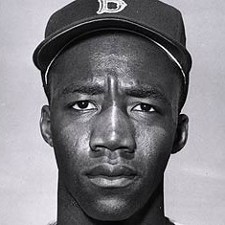
The Red Sox, who passed on Robinson in 1945 and Willie Mays a few years later, have had African-American players, among them Hall of Famer Jim Rice, Mo Vaughn, George Scott, Cecil Cooper, Ellis Burks and Reggie Smith. But today they are one of only three teams without an African-American player on their 25-man roster.
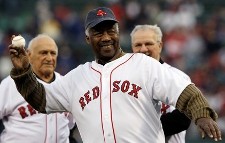
The other two teams are the Kansas City Royals, where Coco Crisp is out for the season with a torn labrum, and the Florida Marlins, with whom Cameron Maybin spent the first five weeks of the season. The Red Sox have no such exceptions. In fact, when they had Green throw out a ceremonial first ball before an April game, they had David Ortiz, a dark-skinned Dominican, catch it because they had no black player to handle the job.
Larry Lucchino, the Red Sox chief executive, rejected any link between past Red Sox culture and today’s Fenway Park environment.
“We are completely free of any biases and points of view that may have characterized baseball in the past,” Lucchino said in a telephone interview. “I know it in my head and believe it in my heart. How it manifests itself at different times can be completely misleading. A momentary snapshot at a point in time can mislead the public.
“You may not see as many African-Americans today as you may see six months from now. There is no validity in comparisons between then and now. No team that wants to be successful in the long term can ignore African-American players. We do not and will not.”
The Red Sox ignored African-American players for more than a dozen years after they invited Robinson to Boston for a tryout, then sent him home without offering him a contract. They never even looked at Mays, even after being tipped to the ability he was showing as a youngster in Westfield, Ala.
In his Pulitzer-worthy 2002 book “Shut Out” about the Red Sox and race, Howard Bryant quotes a Boston scout as saying after suffering through three days of rain, “I’m not going to waste my time waiting on a bunch of niggers.”
Elijah, a.k.a. Pumpsie, Green waited on the Red Sox. Immersed in what can only be considered institutional racism, the Red Sox owner Tom Yawkey, general manager Joe Cronin and manager Mike (Pinky) Higgins had no spot for someone like Green no matter how much talent he displayed.
“I had a great spring,” Green, a former infielder, said in a telephone interview last Friday, asked about his spring training with the Red Sox in 1959 when he was 25. “I had a better spring than anybody in spring training. I never played so well. Matter of fact, I surprised myself. Everything was coming together. I had a great three, four weeks. It was fantastic.
“When they decided to send me down, everybody cried foul. They asked me a whole bunch of questions that I didn’t have answers for.”
 As the 75-year-old Green recalled, speaking from his home in El Cerrito, Calif., the Red Sox made it harder for him that spring by having him break camp with them and travel to Houston for the final exhibition games of the spring.
“It was three days before the season opened,” Green related, “and Higgins took me out of the lineup and said ‘I’m sending you back to Minneapolis.'”
The decision to leave Green in the minors caused confusion with his minor league teammate, Earl Wilson. Gene Mauch told Wilson he was getting his roommate back, Green said, “and he thought I had made the team and he was going to the majors, too.”
Was Green told why he wasn’t staying with the Red Sox? In a word, no. “They just said we’re going to leave you here and you’ll play with Minneapolis who you played with last year and that was it. Mike Higgins didn’t talk a lot.”
Did the decision anger him? “No, I never get angry,” Green said. “Let’s say I was disappointed. I had to answer a whole bunch of questions. It can get to be annoying when so many people ask so many questions. Every one of the Boston sports writers asked me the same question. I said you’re talking to the wrong person. You saw what I did. That got on my nerves.”
Green did not make the team because Higgins had no use for black players. “He never told me he didn’t like me,” Green said.
However, in his book, Bryant cites an episode early in the 1959 season. With the Red Sox struggling with poor infield play, a Boston columnist asked Higgins if he would call up Green, who was playing solid defense and hitting over .300, to bolster the infield. Higgins responded, Bryant writes, by calling the columnist “‘a nigger lover’ and spit tobacco juice on him.”
By the time Green was belatedly and finally promoted to the majors, Higgins was no longer the Red Sox manager. Billy Jurges was, though Higgins would return during the 1960 season and remain the Red Sox manager the last two years of Green’s tenure with the team.
In three and a half seasons with the Red Sox, Green played in 327 games and hit .244. He played in 17 games for the Mets in 1963 and batted .278. His career didn’t last long, but his circumstances make him special. As the 50th anniversary of his major league debut approaches, Green has received renewed recognition. Is he enjoying the attention?
“Yes, yes, yes, yes and yes,” Green said. “I’m getting two or three calls a day. It’s nice to be remembered.”
Until he retired in 1996, Green taught math and coached the baseball team at Berkeley High School. He and his wife Marie, he said, have been married for 50 years, “no, 51 last March,” Green said, “could be 52. I’m not sure. Let’s put it this way. It’s been a long time.”
MR. CONE GOES TO WASHINGTON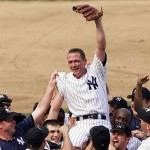
When David Cone went to Washington last week, he was the first baseball player in at least three hearings not to be asked about steroids. Other Congressional hearings in recent years turned out bad for Roger Clemens, Mark McGwire, Rafael Palmeiro and Sammy Sosa. Cone, however, wasn’t at the Capitol to talk about performance-enhancing substances. He was there to talk about Judge Sonia Sotomayor.
“That was nice, not getting a question about that,” he said the next day about steroids.
Cone appeared before the Senate Judiciary Committee, which was conducting a hearing on President Obama’s nomination of Sotomayor for the United States Supreme Court.
“It was a bit of a surprise when I got the call,” said Cone, who was an active officer in the players union when he pitched. “The people who set up the hearing in the White House clearly wanted a baseball player. It’s not likely that any active player was there. I was an obvious choice.”
Cone refered to the 1994 strike that led to the hearing before Judge Sotomayor, who granted an injunction that prompted the players to return to work.
“It was an honor to get to do it,” Cone said the day before the 10th anniversary of the perfect game he pitched for the Yankees. “I got a chance to meet Judge Sotomayor. She was grateful that I appeared.”
Cone read a prepared statement explaining Sotomayor’s role in ending the strike, then answered questions.
 “A lot of people tried to end that dispute,” Cone said, “including President Clinton – we were called to the White House – special mediator, members of Congress. I spent weeks on end in Washington lobbying members of Congress.
“Judge Sotomayor is the one who made the tough, courageous call that put the baseball players back on the field. From my perspective, as a union member, we felt that we were in trouble, that the game was in trouble to the point of almost being irreparably damaged. And she made the courageous decision to put the game back on the field and get the two parties back to the bargaining table and negotiate in good faith.”
If Sotomayor is confirmed, Cone concluded, “I hope the rest of the country will realize, as the players did in 1995, that it can be a good thing to have a judge or a justice on the Supreme Court who recognizes that the law cannot always be separated from the realities involved in the disputes being decided.”
UNUSUAL ICHIRO
 Ichiro Suzuki has played in the major leagues for nine years, and he has been an All-Star for nine years. But in his ninth time this year he showed himself to be an all-star of a human being. While he was in St. Louis, he did something unique to the game of baseball. He visited the grave of George Sisler, the player whose season hits record (257 in 1920) he broke in 2004.
It was Ichiro’s way of paying tribute to the Hall of Fame hitter, who died in 1973, and repaying the kindness of members of Sisler’s family, including his 81-year-old daughter, who traveled to Seattle to watch Ichiro break the record.
“I wanted to do that for a grand upperclassman of the baseball world,” he told MLB.com. “I think it’s only natural for someone to want to do that, to express my feelings in that way.”
His wife and some friends accompanied Ichiro, who left flowers at Sisler’s grave.
Suzuki is unusual in another way. “He manages to sneak off to Cooperstown at least once a year; he’s very interested in baseball history,” said Tim Hevly, the Mariners’ baseball information director.
PRESIDENTIAL RATINGS RATE WITH BUD
Bud Selig was flying, and he wasn’t even on his private jet. It was two days after the All-Star game, and the commissioner was immersed in television ratings and “I told you sos” to this severest of critics of the link between the outcome of the All-Star game and homefield advantage for the World Series.
 To say that Selig was ecstatic would be putting it mildly. He was euphoric, rapturous, delirious with the television numbers. The American League’s 4-3 victory was the highest rated game since 2002, the year before the link was instituted in an attempt to raise the ratings for Fox.
But Selig went beyond the ratings. The game, he said, was played with greater intensity than it had been. Players seemed to care more about the outcome, he said. They stayed until the end of the game instead of scrambling for their private planes the minute they left the game.
The commissioner wasn’t claiming that all of these developments resulted from the World Series link. He was delighted whatever the reason. The ratings, on the other hand, he linked to the link.
One element he overlooked, however, was the appearance of President Barack Obama. Maybe if baseball could secure the president’s services for future All-Star games, the ratings would continue to rise.
Michael Mulvihill, vice president for research and programming for Fox Sports, offered some numbers to show the impact of Obama’s appearance.
“The year-to-year viewership comparison was better for the pre-game show (up 8%) than for the game itself (up less than 1%),” Mulvihill said in an e-mail. “The rating at first pitch was also higher than last year (5%), suggesting that some fraction of the audience came for Obama and then stuck around for at least a portion of the game.
“If you subscribe to the idea that the President is more popular with younger people, it’s interesting that viewing was up by more among Men 18-34 (6%) than among all viewers (<1%). Within the pre-game show, viewing was up 22% among Men 18-34 and 8% overall.”
As for non-presidential matters, Mulvihill and others emphasized the need to take into account the change in television viewing habits.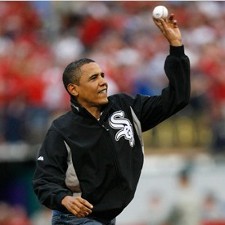
“Broadcast network ratings have been in a general decline for years as viewers have migrated to cable bit by bit,” Mulvihill wrote. “As that’s happened, the relative strength of baseball has actually improved.”
The seven All-Star games that have been played under the Selig link, Mulvihill said, have averaged 13.7 million viewers, which is 31 percent better than the average for all primetime shows over the same seven seasons. In the seven years before 2003, the game averaged 16.7 million viewers, but that was just 26 percent better than primetime shows over the same span.
This year’s All-Star game, Mulvihill said, had an 8.9 rating, which was 48 percent better than the 6.0 average for all primetime shows on ABC, CBS and NBC this season.
“The only All-Star Game to fare better relative to average programming was last year’s game at Yankee Stadium, which rated 55% better than the ABC/CBS/NBC average,” he wrote. “So while the All-Star Game has declined in absolute terms, the last two have been the most successful ever in relative terms.”
Whether the Selig link has had an effect on the Fox ratings remains debatable, and even some Fox people don’t think it has had an effect. But, Mulvihill said, “I do think it’s fair to say that as a television attraction the All-Star Game is as strong as ever or even stronger than ever relative to its competition.”
COLLUSION? WHAT’S THAT?
This does not exactly rate a bulletin designation: Commissioner Bud Selig denied that teams engaged in collusion against free agents last winter. Selig was reacting to an Associated Press report that quoted some player agents as saying they have urged the union to file a grievance alleging collusion, which is a violation of the collective bargaining agreement.
It comes as no surprise that Selig would deny the allegation of collusion. He has never acknowledged that the owners colluded against free agents in the 1980s even though two arbitrators found that they did in three separate collusion cases for 1985, ‘86 and ‘87. The rulings cost the owners, including Selig, $280 million.