Last week I suggested that the Red Sox, with their off-season free-agent acquisitions, were copying the Yankees following their free-agent additions a year ago and World Series championship 10 months later.
I was not suggesting that the Red Sox were wrong for copying the Yankees. Teams in all sports copy winners. By signing John Lackey, the Red Sox have fortified their starting pitching rotation and made themselves very serious contenders to succeed the Yankees as World Series champs.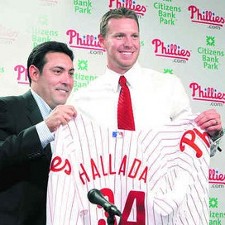
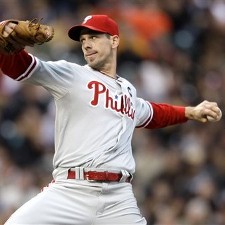
What I will suggest this week is that the Phillies were in perfect position to assume the same role but inexplicably squandered their opportunity. They had a chance to have Roy Halladay and Cliff Lee in their rotation and passed. With Halladay, Lee and a rejuvenated Cole Hamels, the Phillies would have been a formidable bet for a third consecutive National League pennant and a strong contender for their second World Series title in three years.
But, the Phillies’ general manager said, “It wouldn’t guarantee us anything.”
Ruben Amaro Jr. is right. Having Halladay and Lee in the same rotation would not guarantee the World Series. He and every other general manager know that, but they also know how seldom they can expect their team to get to the World Series. Not even Brian Cashman’s job with the Yankees includes a guarantee.
But I sure would rather start out with Lee and Halladay than only one of them. How often does a team have that opportunity?
Given the Phillies’ payroll history, it was easy to think that they opted to trade Lee to the Mariners because they didn’t want to have to pay both him and Halladay. The Phillies play in one of the largest markets in the country, but they have treated their payroll as if they play in one of the smallest markets.
In short, they have cheated their fans, depriving them of stronger teams because they didn’t want to pay the price for winning players. I have, in one file, payroll records dating to 1992, and the Phillies were in the bottom half of the payroll calculations until 2004. In that 13-year period, they finished with losing won-lost records 9 times.
In the past three years, the most successful stretch on the field in their history, the Phillies ranked 8th, 10th and 6th in payroll. It wasn’t No. 1, but the Phillies were paying enough players enough money to turn the team into a contender.
Having broken out of their economic holdback, the Phillies might have been expected to welcome the presence of two pitchers like Halladay and Lee. But no, the Phillies didn’t go for the 2010 championship in December 2009.
Except Amaro said the decision had nothing to do with money.
“My preference would have been to have both of them,” Amaro said, “but at the same time my job is to assure we have success not just on a short-term basis but on a long-term basis as well. I felt this was the best way to do it.”
Amaro was speaking about the Phillies’ minor league system. He had traded four of the organization’s top prospects for Lee last July, and now he had traded three more top prospects for Halladay.
“It would have left us short in the amount of talent at the upper levels of the minor leagues,” Amaro said by telephone from Philadelphia. “We had already moved four good prospects in the Lee trade without replenishing them. We moved three more top prospects for Halladay. In six months we would have moved seven of our top 10 prospects to have one pitcher whom we could have extended a contract to. In my mind that wasn’t the right tradeoff.”
 Asked, however, if he would have preferred having one or both pitchers, Amaro said, “Both certainly. You try to put your best foot forward for this year. Having Cliff and Roy with Hamels in the rotation would have been extraordinary, but it wasn’t the right thing for us to do in the long term.”
Not that he asked me, but I am among those who don’t agree with Amaro’s view. Opportunities to get to and win the World Series don’t come along too often, even though the Phillies have played in the last two and won one. In recent years, I think, the prevailing view has been to take advantage of current opportunities. Tomorrow is another day, Scarlett.
If the Phillies had kept Lee and won the 2010 World Series, then had Lee leave as a free agent and slip back into mediocrity, Philadelphia fans, as brutal and obnoxious as they can be, would be unlikely to complain, at least not immediately. Two World Series winners in three years would mollify them.
Amaro’s job might be to maintain a competitive, if not contending team, but no one could accuse him of failing to do his job if the Phillies had won two World Series in three years. And if Amaro chose to trade Lee for prospects as a hedge against not winning the World Series with him in the rotation, it would be disappointing.
Maybe because I don’t agree with Amaro’s decision to trade Lee, I keep coming back to money as the reason. Maybe the Phillies just didn’t want to pay both Halladay and Lee, and Halladay was willing to sign a shorter contract than Lee would have.
“We could have worked through the finances,” Amaro said, again rejecting the economic explanation. “That wasn’t really an issue. What was critical was we were moving players out of the system without moving any talent back in.”
The Phillies reached agreement with Halladay on a three-year contract extension before the trade was completed. Amaro said the extension was a necessary prerequisite. The Phillies, however, had only preliminary talks with Lee about an extension before they made the decision to trade him. Lee, they determined, wanted more years than they wanted to give him.
“I would have been uncomfortable with the length of the contract,” Amaro said. “We probably could have come to some agreement, but it would have been uncomfortable because of the length.”
As far as my disagreeing with Amaro, he has one thing in his favor. His decision to trade Lee is reminiscent of Cashman’s decision two years ago not to trade for Johan Santana when he had the opportunity.
Rather than give up a chunk of the Yankees’ farm system for Santana and give him an expensive contract extension as well, Cashman decided to wait for last year’s free-agent market, which he knew would include CC Sabathia. Signing Sabathia would cost only money.
The Yankees missed the playoffs in 2008 and almost certainly would have made them if Santana had been in their rotation. But with Sabathia they won the World Series in 2009. Without the knowledge of how far they might have gone with Santana, the Yankees are happy with their 2009 World Series championship.
Without a guarantee for 2010, Amaro is happy that he traded Lee.
“My job is to get us to the World Series and win,” he said, “but you can’t lose sight of the impact things would have on the organization.”