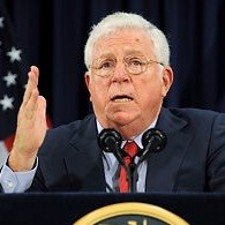
Richard Ravitch is a name that will live in baseball infamy. A lawyer who has held a wide variety of bureaucratic leadership positions, Ravitch was the chief labor negotiator who took Major League Baseball owners into the most disastrous strike in professional sports history.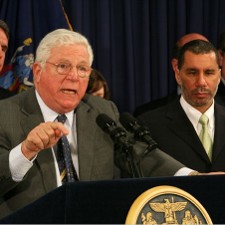
Ravitch was excused from his position in the middle of the strike, but his contributions lived on.
As Michael Weiner the incoming executive director of the players union said, “Ravitch was the one who said initially that revenue sharing and the salary cap were inextricably intertwined, which was a little bit surprising because there would have been an argument that revenue sharing was not a mandatory subject of bargaining.”
That is, the owners would have made that argument. The union agreed with Ravitch’s stated position and didn’t have to make any argument on the subject.
Ravitch, who sort of disappeared from public view following his departure from baseball, is back, not in baseball but in public view, at least in New York State, where Governor David Paterson has named him the state’s lieutenant governor. And just in time to make this Web site on the first anniversary of its beginning.
Paterson needed a lieutenant governor because he had held that position until he became governor in March 2008, replacing Eliot Spitzer, who committed sexual-political suicide that seems to be the rage among office holders.
Ravitch may yet not get to be lieutenant governor. The Republicans have challenged his appointment, asserting that the state constitution doesn’t permit the governor to name a lieutenant governor. But Ravitch’s emergence alone was enough to get me thinking about his baseball past.
I have two favorite Ravitch stories. No. 1 is a question he asked that involved me. After becoming the baseball owners’ chief negotiator, he met and spoke to my wife, Ellen. He apparently was impressed with her (more than he was with me) because he subsequently asked a baseball public relations person, “Why did she marry him?”
To my wife’s credit, she did not then second-guess herself and ask herself the same question.
No. 2, soon after Ravitch assumed his position in 1991 – he was president of the player relations committee, which was management’s labor arm – a New York Times colleague, Claire Smith, and I met with him to introduce ourselves as the Times’ reporters who covered baseball labor negotiations.
At one point in our conversation in Ravitch’s office at M.L.B. headquarters, Ravitch offered us a deal. If we treated him fairly, he said, he would make sure we never got beaten on a baseball labor story. If he learned of a story, presumably through questions from the reporter, and he wasn’t aware that we had it, he would inform us about it.
Neither Claire nor I responded to his offer. We reacted internally though differently. I was astonished, incredulous, that a news subject would make such an offer, but I just laughed to myself at the incredible arrogance the offer demonstrated.
Claire wasn’t laughing to herself or anyone else. During one of Ravitch’s many breaks, she sputtered her outrage over the offer, thoroughly insulted that he thought we would accept such a journalistically repugnant idea. She wanted to jump across his desk and throttle him, but I talked her down and we finished the conversation uneventfully.
What we did was wonder if, in the past he had made similar offers to other news-side Times reporters and if so, had anyone accepted them. We did not ask him about that possibility.
Fortunately Claire and I got through the negotiations without need of Ravitch’s help. In fact, he was gone from the negotiations long before we were. Although his contract ran through the end of 1994, he had ceased being a meaningful participant in talks by the fall of that year. Chuck O’Connor, outside labor counsel from the Washington law firm of Morgan Lewis & Bockius, had supplanted him as chief negotiator.
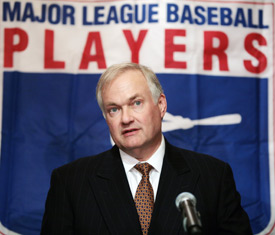
 “Dick Ravitch was brought in as the negotiator without previous experience or familiarity with Major League Baseball or his constituents,” the union’s outgoing leader Donald Fehr said. “After the Kohler meeting on revenue sharing, he was given a series of proposals to present to us. It wasn’t until much later that he came to understand he couldn’t get an agreement based on those proposals.”
The owners hired Ravitch, at the suggestion of the New York Mets’ Fred Wilpon, to extract from the union an agreement that would wipe out much of what the players had gained in the previous 25 years.
Ed Koch, former mayor of New York, questioned baseball’s wisdom in hiring Ravitch, who had worked under him in various capacities. “Nobody from baseball ever called me,” he told a lawyer connected to baseball. “It made no sense.”
Ravitch described himself as a great baseball fan, but his actions belied that status. Riding in a car to the season opener at Shea Stadium with Commissioner Fay Vincent and Deputy Commissioner Steve Greenberg, he asked, “Could you tell me which league has the designated hitter.” And at Shea, looking at the uniform shirts with numbers the Mets had retired, he asked, “Who was 37?” A real fan would have known it was Casey Stengel’s number.
Ravitch was part of the cabal that undermined Vincent and forced him to resign as commissioner. Ravitch and a group of owners, led by Bud Selig and Jerry Reinsdorf, wanted Vincent out of the way because they felt he would interfere with their plan to break the union. According to some people who knew Ravitch his plan was to beat Fehr at the bargaining table, cripple the union and become commissioner himself. 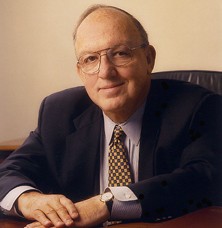
Vincent declined to address the motives ascribed to Ravitch, but he told of a lunch that he had with Ravitch at Ravitch’s request at the end of Ravitch’s reign as labor chief.
“He said ‘I made a terrible mistake,'” Vincent related. “‘When you left, I should have resigned with you. I should have realized it was hopeless. They are what you think they are.'”
The prevailing view of Ravitch’s abbreviated tenure was that he misread the union and didn’t comprehend the gigantic task he faced. “He underestimated his opponents and overestimated his employers,” said a man close to the labor situation.
Before he took the baseball job, Ravitch had limited negotiating experience, having bargained with the Transport Workers Union as head of the Metropolitan Transportation Authority in New York. He approached baseball bargaining with the idea that he and Fehr would privately and quietly sit down somewhere together, have a couple of drinks and work out a deal. Then they would go to their respective constituencies and tell them, “This is the best I can do.”
What Ravitch didn’t know was that Fehr doesn’t negotiate that way. Just as Marvin Miller did before him, Fehr involved his members in planning and bargaining. No backroom agreement would develop here.
Instead the players rejected a payroll cap, went on strike and stayed on strike for 234 days. Three months after Ravitch’s contract ended, a Federal judge and now Supreme Court nominee, Sonia Sotomayor, granted an injunction that induced the players to end their strike, something Ravitch couldn’t do.
