The last time the All-Star game was played in St. Louis, in 1966, the National League team featured a dazzling array of superstars and future Hall of Famers.
Half of the infield – first baseman Willie McCovey and second baseman Joe Morgan – and the entire  outfield – Roberto Clemente, Willie Mays and Henry Aaron – would wind up in the Hall of Fame. So would the league’s starting pitcher, Sandy Koufax; the others who pitched for the N.L. in the game – Jim Bunning, Juan Marichal and Gaylord Perry – and Bob Gibson, who was selected for the team but couldn’t play because he developed an arm ailment.
The N.L. team was as hot as the weather – 105 degrees. If not hotter.
“No telling what the temperature was,” said Tim McCarver, who singled leading off the 10th inning against Pete Richert and scored the winning run on a single by Maury Wills for the National’s 2-1 victory. “It may have said it was 105, but outside at Busch Stadium it was two floors below street level. You got no wind to cool off with, no draft. It made things more insufferable.”
McCarver replaced Joe Torre as the N.L. catcher at the start of the eighth inning. “I asked Torre how ya holding up,” McCarver recalled. “He said I’ve taken only 12 salt tablets. Those days if you took four it was supposed to be enough. We found out later they were detrimental.”
Before the game, McCarver recalled, he was in the trainer’s room briefly and noticed the trainer applying heat ointment to Koufax’s left arm. “If you used it full strength, it would blister your skin,” McCarver said. “We’d cut it with Vaseline. Sandy used it full strength. He had his pants on and no shirt. His left arm and back were beet red. I said you don’t use that stuff full strength, do you? He said yes.”
“I was thinking he must be in a lot of pain,” McCarver added, “and he retired at the end of the year. I faced him sometime in the second half. He wasn’t right. Of course, he ends up winning 27 games.”
At the All-Star break Koufax had a 15-4 record. It was the sixth season of a remarkably divided career in which Koufax needed six years to discover how to pitch and use the magical talent he had and then pitched six years with mesmerizing and overwhelming ability that made him the most dominant pitcher in the majors.
With his 15 first-half wins, Koufax was an easy choice for Walter Alston, himself a future Hall of Famer, to make as the N.L.’s starting pitcher. As a young baseball writer covering his first All-Star game I was delighted to have the opportunity to cover a Koufax start.
Like many others, I was captivated by Koufax the pitcher. On the day before the game, I became captivated by Koufax the person.
I was working for the Associated Press, and a colleague and I were assigned to be part of a team trying to get Koufax the day before the game, interview him and write a comprehensive article looking ahead to the game. Achieving this assignment would not be easy because everyone wanted to talk to Koufax, and he wasn’t expected to be available to anyone.
Mike Rathet, a reporter senior to me, and I had one advantage. Koufax was flying to St. Louis from Los Angeles, and someone knew what flight he was on. The local AP bureau sent a reporter to the airport to get Koufax when he arrived there so Rathet and I would not necessarily be the first line of offense.
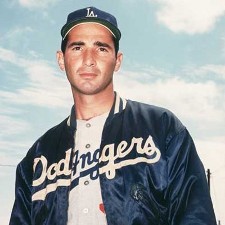 That is, until the local reporter called and informed us that he had missed Koufax. Well, at least we knew that the Dodgers pitcher was on his way to the hotel. We waited in the lobby and were there when Koufax arrived. We introduced ourselves to him and began asking questions.
As polite a player as I have ever met, Koufax answered our questions, standing in the middle of the lobby. The interview was going well when the public relations director for Major League Baseball, Joe Reichler, until recently an AP baseball reporter himself, interrupted us.
“Boys,” he said, clearly trying to ingratiate himself to Koufax, “Sandy just flew cross country, he’s hot, he’s tired. Let him go up to his room, take a shower, change clothes and then you can continue.”
Before we could say anything, Koufax said, “No that’s all right. I’ll finish now.”
And he did, answering all of the remaining questions. Every other player would have leaped at the opportunity to get away from two reporters. Koufax, as classy a gentleman as ever played the game, finished the interview as politely as he began it. I can’t say that I had a comparable experience in the ensuing 43 years.
The next day Koufax was not so perfect. He actually gave up a hit and a run in his three-inning effort, though both were avoidable.
With one out in the second inning, Brooks Robinson, who would rap three hits in the game, hit a line drive to left field, where Aaron was playing because Clemente with his stronger arm was playing right, Aaron’s usual position.
“I’ve been having a lot of trouble with my curveball, and I’m not throwing nearly as hard as I used to” Koufax said after the game. “When I got to 2 and 0 on Brooks, I knew I had no curveball. I just threw the fastball and hoped he wouldn’t hit it out.”
Robinson didn’t hit it out, but he hit it hard. “I lost the ball in the background of white shirts,” said Aaron, who hadn’t played left field in more than a decade. Once he picked up the ball, he tried to make a diving catch, but he missed the ball and it went for a triple.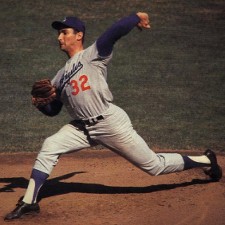
Koufax induced the next batter, George Scott, to hit a foul popup, but with Bill Freehan at bat Koufax threw a wild pitch, allowing Robinson to score. “The curveball just took off,” Koufax explained afterward.
Koufax had retired all four hitters before Robinson’s triple, and he retired all five hitters after the gift hit. In what would be the last of six career All-Star innings, Koufax retired Bobby Knoop on a grounder to third, struck out Denny McLain and got Dick McAuliffe on a foul pop.
Aaron’s misplay that became a triple served bizarrely as an omen of the disaster that would befall Koufax in the last game he would pitch. Three months later, after he pitched and won the final regular-season game for his 27th and the Dodgers’ pennant-clinching victory at Philadelphia, he started Game 2 of the World Series against Baltimore.
The Dodgers committed five errors behind him, three in the fifth inning by the fine center fielder, Willie Davis, who lost two fly balls – one deep, one shallow – in the sun, then dropped both and threw wildly to third after the second one. The Orioles scored three unearned runs of the four runs Koufax would allow in six innings and beat him, 6-1.
Plagued by an arthritic left elbow, Koufax announced his retirement shortly afterward, two months before his 31st birthday. Had today’s medical technology been available, he most likely could have surgery to make his elbow healthy enough to continue pitching for many more years.
Efforts to reach Koufax to discuss the 1966 All-Star game were unsuccessful. He has made himself virtually invisible, preferring airtight privacy. Invited to sit for an interview for an oral history project, he declined, saying nobody wanted to read or hearing anything he had to say. His modesty was as great as his pitching ability.
TAPING THE UMPIRES
A play at third base in a game last week between the Yankees and the Blue Jays created a huge he said-he said dispute. With no recording of the verbal aftermath of the play we’ll never know who was right, but what umpire Marty Foster said to Derek Jeter after calling him out trying to steal led to a second phase of the dispute involving the chief of the umpiring crew, John Hirschbeck.
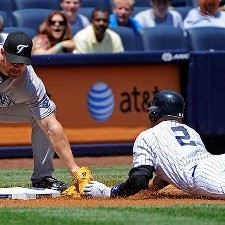 According to Jeter, Foster told him the ball beat him to the bag and Scott Rolen, the third baseman, didn’t have to tag him for him to be out. Hirschbeck subsequently told reporters that explanation would be wrong if that’s what Foster said. Hirschbeck also praised Jeter, saying he “might be the classiest person I’ve ever been around in uniform” in his 27 years in the majors.
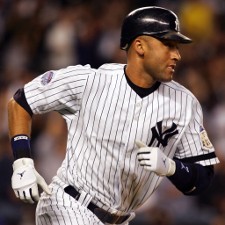
But Hirschbeck felt that an erroneous interpretation was attached to his comments, especially the part where he was quoted as saying Foster had been wrong.
“I don’t know where that came from,” Hirschbeck said in a telephone interview. “I said I have not had a chance to speak to Marty about what he said, but if in fact he told Derek the ball beat you, it was the wrong thing to say to a player.”
Hirschbeck said he talked to Foster the next day, and “Marty told me that was not what he said. He said he told him ‘the ball beat you and I had him tagging you.'”
Years ago, Hirschbeck said, before the scrutiny of television cameras, “you would hear that the ball beat him and the guy is out, but it’s not like that anymore. You got to tag the guy.”
Do all umpires abide by the tag guideline? “Absolutely all umpires do that,” Hirschbeck said. “Nowadays if an umpire told a player the ball beat you so you’re out it’s wrong. But Marty told me that’s part of what he said, but it’s not the whole statement.”
Jeter rejected Foster’s explanation to Hirschbeck, saying that Foster said nothing about being tagged. Now that baseball has introduced replays to check home run calls, maybe it could add audio to the video to determine who said what to whom.
DON’T IGNORE THE GIANTS
The way the Los Angeles Dodgers have played this season, refusing to let the 50-game absence of Manny Ramirez affect them, it would seem highly unlikely that anyone can catch them in the National League West. But I say don’t ignore the San Francisco Giants.
The Giants, leading the N.L. wild-card standings, have had an impressive month, compiling a 17-10 record highlighted by Jonathan Sanchez’s no-hitter against San Diego Friday night. The 26-year-old Sanchez, who went into the game with a career 15-26 record and 5.21 earned run average, was one batter from a perfect game, allowing only one baserunner on an error by Juan Uribe at third base.
No-hitters don’t necessarily mean anything for future performances, but Sanchez had been the Giants’ least effective starter. At the head of the rotation are Tim Lincecum and Matt Cain, each with a 10-2 record. Randy Johnson, at 8-6, has been inconsistent and is currently on the disabled list with a strained left shoulder.
The key to how far the Giants go could be Barry Zito. A huge and expensive disappointment, Zito has shown flashes of being able to win more for the Giants.
After winning only one of his first seven decisions, Zito has won four of his last six and has been impressively effective in some of his recent starts, pitching 8 1/3 scoreless innings in his last start, for example. But he has still been too inconsistent for the Giants to count on for a sustained charge on the Dodgers.
In the field, the Giants began the season with an entirely new infield. They have had mixed results. Second baseman Emanuel Burriss hit only .238 in 61 games and, mired in a 0-for-27 slump, was returned to the minors June 16 for further seasoning. Shortstop Edgar Renteria, the only veteran in the infield, was hitting .263 through Friday, below his .290 career average, but he had a .321 on-base percentage, closer to his .347 career mark.
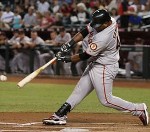 First baseman Travis Ishikawa was hitting only .219 in 33 games on May 24, but in 28 games since batted .100 points higher.
The standout member of that new infield has been third baseman Pablo Sandoval (left), who through Friday was hitting a team-best .331 and also leading the Giants with 14 home runs and 53 runs batted in.
The Giants’ biggest problem in trying to move closer to first place in the division has been the Dodgers. While the Giants were compiling a 17-10 record the past month, the Dodgers had a 15-10 record, enabling the Giants to gain only a game, reducing their eight-game deficit to seven.
NEW EYE CHART: R Z E P C Z Y N S K I
The Toronto Blue Jays have another rookie starting pitcher, their fifth this season, but this one might more easily be confused with an eye chart. Marc Rzepczynski is a 23-year-old left-hander who made his major league debut July 7 against Tampa Bay, allowing one run and two hits in six innings in a 3-1 Blue Jays loss.
Rzepczynski was selected in the fifth round of the 2007 draft. When the Blue Jays drafted Rzepczynski, I asked Jon Lalonde, their scouting director, did they say his name or did they submit it in writing?
“That’s a good question,” Lalonde said, laughing. “I had to rely on my area scout who had been to his school and heard his name over the p.a. system.”
Lalonde also helped with the pronunciation of the name of the pitcher, who was scheduled to start in Baltimore Sunday. It’s Zepchinski.
