This could be confusing so pay attention. This year’s Super Bowl between Seattle and Denver will feature a quarterback who played two years of minor league baseball against a team that is run by a fellow who quarterbacked it to two Super Bowl championships after playing one year of minor league baseball.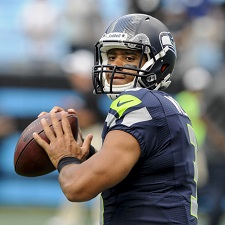
Russell Wilson, the Seahawks’ quarterback, and John Elway, the Broncos’ executive vice president of football operations, are not the only athletes – far from it – who have played baseball and football, not even the only ones who have played both professionally. But they stand out at the moment because of the coincidence of their presence at the game in East Rutherford, N.J.
Elway has had his time, playing in five Super Bowls, being named most valuable player in the last one, which was also the last game of his career, and gaining election to the Pro Football Hall of Fame.
There’s no do-over so we’ll never know how an Elway baseball career would have turned out, but in his lone minor league season, 1982 at Class A Oneonta (N.Y.), he was impressive. A left-hand hitting outfielder (he threw a baseball right-handed as he did a football), he batted .318 with 4 home runs and 25 runs batted in for his 42-game season.
Elway and Wilson actually had similar starts to their non-baseball careers. Both were drafted out of high school (in low rounds because they were committed to colleges), Elway by Kansas City, Wilson by Baltimore. Their second time around, Elway was drafted in the second round by the Yankees, Wilson in the third round by Colorado.
“I had watched him play a lot of football,” Danny Montgomery, the Rockies’ assistant scouting director, said. “I knew there was something special about him. I liked his preparation. When I watched him in baseball, he would sit there after batting practice and watch the other team take batting practice.”
Jay Matthews, the Rockies’ national cross checker, began following Wilson when he was a high school freshman in Richmond, Va. He pitched and played left field, but as Matthews and Montgomery watched him in subsequent seasons, in Richmond and at North Carolina State, they envisioned another position for Wilson.
“We were convinced that he was athletic enough to play the infield,” Matthews related by telephone from San Juan. “We drafted him as a second baseman a la Jerry Hairston, that type of player. We were convinced if he had stayed with baseball, with his mindset and work ethic, he could have done well.”
Wilson, at the age of 21, played for the Tri-City Dust Devils in the low A Northwest League in 2010 after his third and last year at North Carolina State. He hit .230 (28-122) with 4 doubles, 4 triples, 2 home runs, 11 r.b.i. and 4 stolen bases in 10 attempts.
Moving up in 2011 to the Asheville Tourists of the Class A South Atlantic League, Wilson batted .228 (44-193) with 5 doubles, 4 triples, 3 home runs, 15 r.b.i. and 15 stolen bases in 17 attempts. He obviously learned something about stealing.
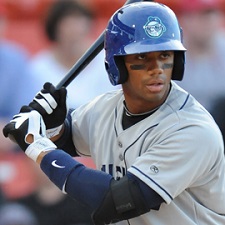 “He had natural talent in baseball,” Matthews said. “He played well at second base. He adjusted to that position very quickly. We felt if he had 1,500 at-bats in the minors, he could have been a good baseball player. He had a great work ethic. He was the first guy at work in the morning and one of the last to leave. He has an infectious personality, and he makes everyone around him better.”
Wilson also impressed Sam Hughes, national cross checker for the Chicago Cubs.
“One thing that stuck out then and now,” Hughes said, “is his athleticism and on-field presence that comes across with a maturity and a presence that a lot of other kids didn’t have. You always noticed him so seeing him on a big stage like this is not a shocker.”
Wilson, relatively small at 5-feet-11, never lost his desire to play both football and baseball professionally, as Bo Jackson and Deion Sanders did.
“I stayed in touch with him and his family,” Matthews said. “He was determined to do both.”
He hasn’t done both beyond his two-year term in the Rockies’ system, and it’s highly unlikely that he will resume his quest after his early success in the National Football League and a two-year absence from baseball.
Wilson, 25, has made a remarkable start in the N.F.L., winning the job as Seattle’s starting quarterback in his rookie training camp, then guiding the Seahawks to the playoffs as an N.F.L. neophyte and now to the Super Bowl in his second season.
Players and other Super Bowl team personnel are impossible to get for interviews in the two weeks before the game except on media days the week before so I was unsuccessful in getting Wilson or Elway on the phone.
However, in my research for this column, I found a couple of things worth quoting on the subject.
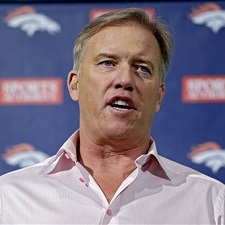 First, this from Elway, speaking of a meeting before Wilson was drafted in 2012:
“We had him in. We loved the kid. To see what he’s doing, you know when you met him that he had the capability because of the presence that he has, that he had the ability to do what he is doing right now. He’s athletic, can make all the plays and has the right attitude.”
Then there is Jon Daniels, general manager of the Texas Rangers, who selected Wilson from the Rockies in last December’s minor league draft. Wilson had remained on the Rockies’ minor league roster, though he was not protected from the draft because he wasn’t on the 40-man roster.
“We talk to our scouts about the makeup we want of our players and the work ethic it takes to win,” Daniels said, “and Russell Wilson has been an example of that. He has off-the-charts character and focus.”
It cost the Rangers only $12,000 to draft Wilson, and they don’t expect to get their money’s worth by having Wilson try to win a job with them. They are looking for Wilson to motivate their young players. They wouldn’t mind if he also inspired their veteran players.
“I’m sure I’ll go down there for spring training and just talk to some of their players and hang out some,” Wilson said. “It’ll be kinda cool. But that’s down the road. I’m trying to win a game this week.”
And Wilson again when he was asked what he was thinking in the final seconds of the Seahawks’ National Conference title game victory over San Francisco:
“To be honest with you, the thing that I thought about during the last snap was, ‘Man, I could have been playing baseball right now.’’’
Matthews and Montgomery don’t begrudge Wilson his success as a quarterback, a smallish quarterback at that.
“We talked a lot about his makeup,” Matthews when asked about Wilson’s size. “It’s amazing what people can do. People told him he was too small but he had perseverance and conviction. With his makeup and work ethic, it’s what the kid is all about.”
“We think the world of him,” Matthews added, “and wish him the best.”
EENY MEENY MINEY MO
John Elway and Russell Wilson are not the only quarterbacks who have been objects of competition between baseball and football. Recent drafting history is filled with quarterbacks who were selected in both baseball and football drafts and had to choose one or the other or choose neither and attend college, perhaps playing both sports and postponing their decision.
Among the better known quarterbacks who chose football were Dan Marino, Tom Brady, Duante Culpepper and Michael Vick. In the NFL’s recent National Conference championship game, the opposing quarterbacks, Wilson and Colin Kaepernick, both selected football.
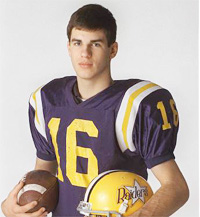 Preferring to go in the other direction were Joe Mauer and Carl Crawford. The University of Nebraska recruited Crawford while Mauer was the Gatorade national player of the year and signed a letter of intent to play at Florida State.
Gabe Gross was Auburn’s starting quarterback for six games as a freshman in 1998, but the outfielder decided he preferred baseball and was Toronto’s first pick in 2001.
Joe Borchard played both sports at Stanford and was in line to be the starting quarterback in 2000, but he signed with the Chicago White Sox after they made him the 12th player picked in that year’s baseball draft.
Trot Nixon signed a letter of intent to be North Carolina State’s quarterback in 1993, but Boston made him the seventh player picked in the draft, and he signed with the Red Sox.
The University of Washington recruited Grady Sizemore to play both sports, but when it was time to choose a profession in 2000, he opted for baseball.
Adam Dunn, a quarterback in high school, was a scholarship football player at the University of Texas but after the spring football game he declined to change positions and went to baseball instead, signing with the Cincinnati Reds in 1998.
Mark DeRosa was an Ivy League baseball and football player at the University of Pennsylvania, starting at quarterback for three years, but when Atlanta drafted him in 1996 he pronounced himself a baseball player and signed with the Braves.
Todd Helton, who has pronounced himself retired, had one of the more interesting baseball-football experiences. A two-sport athlete at the University of Tennessee, Helton was scheduled to be the backup quarterback in 1994.
However, the starter, Jerry Colquitt, was injured in the season opener, and Helton took over. He started the next three games but then suffered a knee injury. His replacement was a freshman named Peyton Manning.
After Helton switched to baseball and became the Colorado Rockies’ first baseman, he had a teammate, Seth Smith, who also had been a college quarterback. Smith was a backup for three seasons at Mississippi. The starter? Eli Manning, Peyton’s younger brother.