One of the most irritating byproducts of the ongoing Alex Rodriguez saga is that it detracts attention from the entertaining stories in baseball. Let’s hear less about the Joint Drug Agreement and more about the Pirates, who own the second-best record in baseball and are poised to finish above .500 for the first time since 1992. Let’s also read less about an anti-aging clinic in Florida and more about the Royals, in the midst of a 15-3 streak and firmly in contention for their first playoff berth since 1985.
For fans of the Yankees, the Rodriguez fiasco, though frustrating, at least has the silver lining of distracting from the poor performance by the rest of the team. As long as Rodriguez is being booed, the rest of the team is spared the same, possibly deserved, treatment. Only once have the Yankees missed the playoffs in the wild card era, but they sit seven games back of the second wild card spot and must hurdle four teams to reach that position. With a 58-57 record, they are in danger of becoming the reverse Pirates: finishing with a losing record for the first time since 1992. Just as an entire generation of fans in Pittsburgh and Kansas City prepares for its first set of meaningful games in September, the similar batch of Yankee fans must brace itself for the opposite.
As much as its starting rotation has been plagued by the inconsistencies of starters CC Sabathia and Phil Hughes, New York ranks a respectable fifth in the American League and first in its division in earned run average (3.76). Hiroki Kuroda’s 2.45 ERA is good for second in the league, Ivan Nova has a 1.60 ERA since the start of July, and David Robertson and Mariano Rivera – two recent blown saves notwithstanding – continue to excel at the end of games.
In a twist on traditional Yankee dynamics, the problem lies with the offense; the Bronx Bombers have become pacifistic in 2013. Across the board, the Yankees’ offensive rankings have plummeted from last year to this.
This season represents the reversal of a decade of offensive dominance. Between 2004 and 2012, the Yankees ranked first or second in runs scored every year but one; the last time they were even in the bottom half of the league was 1996.
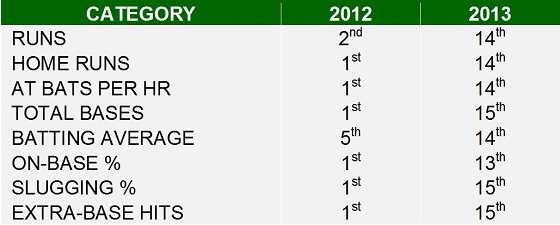
The home run struggles are even surprising given the home stadium’s hitter friendliness, but if the Yankees remain mired in the bottom two, it will be their first time finishing so low in the category since 1970, when Mariano Rivera was not yet one year old.
Ten Yankees tallied double-digit home run totals last year, and only Robinson Cano has remained available and productive for the team this season. Nick Swisher, Russell Martin, Raul Ibanez, Eric Chavez, and Andruw Jones have all departed the Bronx, and the foursome of Rodriguez, Curtis Granderson, Mark Teixeira, and Derek Jeter combined to appear in only 24 games before the All-Star Break. That’s 194 homers (79% of the team’s total) the Yankees have missed in 2013.
The replacements? Kevin Youkilis hit .219 and struck out more than once a game in his short stint with New York before undergoing surgery, which has likely ended his season and Yankee career. Travis Hafner slugged .667 and blasted six homers in April but has hit below the Mendoza line and managed just six more home runs in the three-plus months since. Vernon Wells also hit six in the season’s first month, but he hasn’t homered since May 15. Only four players – Cano, Lyle Overbay, Hafner, and Wells – have double-digit totals, and no other Yankee is on pace to reach the 10-homer plateau.
The hope with Rodriguez’s return was that any production he could provide would be an improvement to New York’s offense, as third base has been a revolving door of ineptitude for the Yankees; players at that position have managed a league-worst .214 batting average and .284 slugging percentage. Most embarrassingly, they have been out-homered by Cubs’ pitchers (5-4). But that performance level is to be expected when the players manning third are Youkilis, Jayson Nix, David Adams, Luis Cruz, Chris Nelson, Brent Lillibridge, Alberto Gonzalez, and, recently, Rodriguez.
But third base isn’t the only position from which New York has had a dearth of output. Yankee shortstops have also hit just .214 with four home runs, and their slugging mark of .300 ranks last in the AL. New York also sits last in slugging percentage from catchers (.323) and both batting average (.223) and slugging percentage (.334) from left fielders, and second-to-worst in first basemen’s slugging (.387), right fielders’ slugging (.372), and designated hitters’ batting (.206).
Fans aren’t asking for a murderers’ row, but trotting out the likes of Ben Francisco and Reid Brignac for 44 at-bats each – good for a combined .114/.179/.159 slash line – doesn’t quite scream offensive juggernaut. Even a peak, pharmaceutically enhanced Rodriguez couldn’t save this offense.
Trade deadline acquisition Alfonso Soriano hasn’t been a savior either, instead fitting right in with his new team by compiling a .200 batting 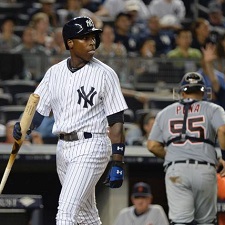 average in 13 games with the club. In his two most recent games, against the Tigers, he struck out three times with a runner on third and fewer than two outs.
The season isn’t yet lost, but with a 7-13 record since the All-Star break, including a 1-5 mark in a six-game stretch against the woeful Padres and White Sox, the Yankees are heading in the wrong direction. But save an extended Jeter comeback, their lineup is set for the rest of the season, and the big worry is that the same problems that have afflicted the team this season will reoccur in 2014.
Help from the minors isn’t coming anytime soon. Catcher Gary Sanchez, who was promoted to Double-A Trenton last week, was the only Yankee minor leaguer to appear on Keith Law’s midseason list of the top 50 prospects in baseball, and the rest of the team’s top prospects – Mason Williams, Tyler Austin, and Slade Heathcott, to name a few – have all taken steps back this year.
That the minor league system is barren of major league-ready hitting talent continues a troubling trend. As hard as it is to believe, the last position player picked in the first round by the Yankees to amass even 10 at-bats with the team is Derek Jeter. This fact is somewhat misleading because the team has picked productive pitchers such as Phil Hughes and Joba Chamberlain early in the draft, but it is an indictment of how poor New York’s prospect development has been that Cano and Brett Gardner are the only capable hitters to have been brought up through the system in recent years.
Though playing young, controllable players is more cost-effective than building a roster of veterans making eight figures a year, the Yankees have patched holes in the past by inking premium free agents to expensive deals. For instance, after missing out on the 2008 playoffs –
though if the current system of two wild cards had been in play then, they would have played in the postseason – the Yankees went on an unprecedented spending spree, shelling out $423.5 million for Sabathia, Teixeira, and A.J. Burnett, and were rewarded with their 27th World Series title the next October.
But with more teams locking up young talent to lengthy contract extensions before the players can reach the free agent market, pickings this winter will be quite slim. Jacoby Ellsbury of the Red Sox will be available but, as a more expensive version of Gardner, superfluous, while the other top free agents – Brian McCann, Shin-Soo Choo, and Carlos Beltran – will all be in their thirties by the time next season begins.
Being old isn’t necessarily a problem. Per Baseball Reference’s average age metric, which is weighted based on number of at-bats and games played, New York’s batters this season have an average age of 31.6 years, a full year lower than in 2012, when the team led the league in most offensive categories. The Yankees last had an average batters’ age below 30 in 1993, and it’s almost ingrained in their nature by this point to pursue veterans, whether through free agency or the trade market, rather than develop players themselves.
The difference between this year’s team and previous iterations is that the 2013 version simply doesn’t have many good players. Cano and Gardner are the only players on the active roster producing at an above-average level per the sabermetric measure OPS+, and it would be hard to claim much differently going by the eye test.
Injuries haven’t helped as the expected starters at catcher, first base, shortstop, third base, and left field have missed significant time, as have key role players such as Youkilis and Eduardo Nunez. Zoilo Almonte provided a spark in the outfield before joining the injury brigade. At one point, the Yankees’ starting shortstop, backup shortstop, and backup-to-the-backup shortstop – Jeter, Nunez, and Nix, respectively – were all on the disabled list.
Yet depth is an important, often overlooked component of a winning team, and one need only examine Oakland’s success despite injuries to a number of its top players for evidence. The blame lies with the Yankees’ front office that the team’s depth, which should have been an even greater priority for a team full of players on the wrong side of the aging curve, consisted of scrap heap pickups and lackluster minor leaguers best suited for a token September call-up.
The problem is that high-quality players cost money, and in a most anti-Yankee turn of events, the Steinbrenner sons want to stop spending (spending, of course, is a relative term here, as I’m sure fans of the Marlins and Astros would attest). Their goal is to slash next season’s payroll under $189 million, thereby resetting the scale by which they must make luxury tax payments and potentially saving them tens of millions of dollars, as well as allowing them to start spending anew in 2015 without incurring severe penalties. The $189 million threshold was the main reason, for instance, that the Yankees didn’t push hard to resign Swisher or Martin to multiyear deals last offseason.
It seems wildly far-fetched to plan such a massive cut in just two seasons, and indeed, even with the unusual stinginess last offseason, the 2013 payroll is a bloated $228 million, the highest in league history. Approximately $94 million coming off the books due to free agent departures will help matters, but while most of those players are unlikely to return, resigning Kuroda and Cano should be a priority. The latter figures to command upwards of $20 million a year in his new contract, particularly if he can spark a bidding war between the deep-pocketed Yankees and Dodgers. If Rodriguez’s suspension for the 2014 season is upheld, New York can devote his $26 million salary toward a new contract for Cano.
Rebuilding isn’t a realistic option in the Bronx, where anything short of a World Series title is considered a failure.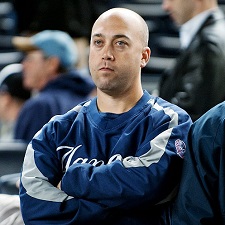 Thus, the Yankees are at a crossroads, with ownership’s goal to reduce payroll diverging from the organization’s goal to win. They lack sufficient talent to sustain success going forward unless they splurge in free agency for proven, aging players, as they have spent most of the Steinbrenner era doing.
But in the new regime of purported fiscal responsibility, the erstwhile approach of buying All-Stars cannot flourish. The untenable Rodriguez contract is a chief example of how large, lengthy contracts can go wrong and strain the team’s ability to sign impact players, and even the three big contracts signed after 2008, which worked wonders in 2009, grew onerous quickly. Burnett was unceremoniously shipped to Pittsburgh for salary relief; Teixeira’s production has dropped steeply since joining the team, and he hasn’t hit better than .256 since his first season in pinstripes; and Sabathia’s high innings totals look to be catching up to him as he suffers through his worst season as a pro.
Using these contracts as warnings, it might make sense to let Cano walk if his demands are too extravagant, but the list of All-Star free agents who have left the Yankees is shorter than Eddie Gaedel. Cano is still one of the best second basemen in the league, and keeping him on the elite list of stars who have played for one team their entire career is enticing from a nostalgic standpoint. As long as signing him doesn’t use up all the money the owners are willing to spend, it would be hard to convince fans that being outbid for the team’s best player is a winning move.
The Yankees need to import not only hitters for the middle of the order but complementary pieces as well. I know it’s easy for me to say because it’s not my money being spent, but it’s up to the Steinbrenners to open the checkbook and bring back the Evil Empire.
“WAR” WAR ROUND 2 UPDATE
Three weeks ago in this space, I predicted that by the end of the season, Mike Trout would overtake Miguel Cabrera in wins above replacement, ensuring a repeat of last year’s Most Valuable Player debate. It has happened sooner than expected; the combination of Cabrera missing a week’s worth of games due to injury and Trout somehow hitting even better than he did in the season’s first half has pushed the latter to the top of the WAR leaderboard as measured by both Fangraphs (7.4 to Cabrera’s 6.7) and Baseball Reference (6.4 to 6.3).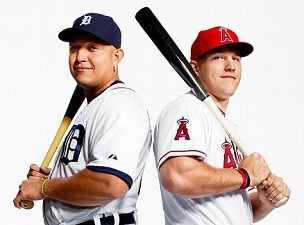
At this rate, Trout could finish with a sizable lead over his closest MVP competitors and again champion the WARmongers’ cause in defining value. But as the Angels have continued to wallow under .500 and the Tigers now lead the AL in winning percentage, Cabrera has a significant advantage when considering the award’s history of voters favoring players on winning, particularly playoff-bound, teams.
In traditional stats, Cabrera continues to run away with the batting title, though Trout has crept to within two percentage points of the second spot. Baltimore’s Chris Davis is making it hard for Cabrera to repeat as Triple Crown winner, however, leading by seven in home runs and tying the Tigers’ third baseman with 109 runs batted in.
Will Cabrera be penalized for not winning the Triple Crown even though his raw numbers are better this season than last? Will the struggles of Trout’s teammates once again prevent him from taking MVP honors? Will Davis make the two-person battle a three-way war? If so, will it become part of the WAR War? As long as the trio keeps hitting, voters will again have a tough task answering these questions when selecting the MVP.