The headline reflected the current cry from too many baseball observers. “High-Payroll Teams Likely To Dominate MLB Postseason,” it said. It is baseball’s version of the fable “Chicken Little, or The Sky Is Falling.”
In the words of Wikipedia, the online encyclopedia, “The phrase, ‘The sky is falling,’ has passed into the English language as a common idiom indicating a hysterical or mistaken belief that disaster is imminent.”
As it applies to baseball, the cry about high-payroll teams is both hysterical and mistaken. Anyone who cries that baseball’s sky is falling hasn’t been watching or keeping track of playoff developments in recent years.
Yes, high-payroll teams make the playoffs. That’s like the police captain discovering that gambling goes on at Rick’s in the film “Casablanca.” But why shouldn’t high-payroll teams make the playoffs? Should they be penalized for having high payrolls?
But what these baseball Chicken Littles overlook is that lower-payrolls teams also make the playoffs and sometimes even advance deeper into October than their high-payroll brethren.
Only two years ago the four teams that played in the league championship series were the Red Sox, with the second highest-payroll that year, and three teams in the bottom third of the payroll standings, the No. 22 Indians, the No. 23 Diamondbacks and the No. 26 Rockies.
Does the final four have to include three lowest-third teams every year for all of the Chicken Littles to mute their cries?
Yes, the four teams with the highest payrolls in the American League will be in the A.L. playoffs this year if the Tigers hold off the Twins. They are the Yankees (No. 1 over-all), the Tigers (4th), the Red Sox (5th) and the Angels (8th).
But what about the National League? The N.L. might lose the All-Star game every year, but their playoffs count. Sometimes the winner of their playoffs even wins the World Series. Yet the teams with the two highest payrolls in the league will not play post-season games this year. The Mets, second over-all, and the Cubs, third, have other work to do.
The N.L. playoffs will have the teams with the sixth (Phillies), seventh (Dodgers), 12th (Cardinals) and 17th (Rockies) payrolls if the Rockies maintain their wild-card lead. The Cardinals began the season in the lower half of the payroll standings, which are based on figures compiled by the commissioner’s office, but traded their way into the upper half.
It’s not as if all of the high-payroll teams battered their way into the playoffs. The Tigers, as of mid-week, were still trying to hold off the Twins, who rank 24th in the payroll standings. The Angels spent most of the season brushing back the No. 20 Rangers. The Phillies survived late-season challenges from the No. 13 Braves and, even more interesting, the No. 30 Marlins.
Had the season continued much longer, the Dodgers might not have been able to hold off the No. 17 Rockies.
The Chicken Littles could argue that in each instance the high-payroll contender was able to hold off the lower-payroll challenger because having spent more money, it was deeper and better fortified to win. How explain, then, the instances where high-payroll teams don’t reach the playoffs? Injuries? Underachieving players? Poor managing?
Why aren’t the Mets and the Cubs in the playoffs this year? The Mets have an easy answer. Injuries decimated them, though there are those who believe the Mets would not have reached the post-season even if completely healthy. But they don’t get a do-over so we’ll never know.
The Cubs are classic underachievers, though injuries contributed to their disappointing season but to a far lesser extent than the Mets experienced.
Having six of the top eight payroll teams in the playoffs will be the most in recent years but by only one team over 2007.
Five of the eight teams with the highest payrolls also made the playoffs in 2004. It could be said that high-payroll teams dominated the playoffs that year and in 2007 and that nothing is new about this year’s post-season lineup, but Chicken Little-like cries weren’t heard in those years.
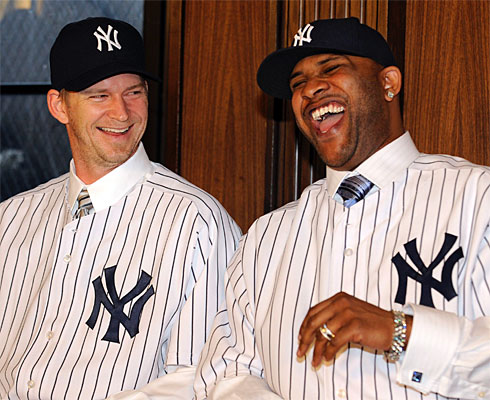 Why are those cries being wailed this year? I think the explanation is pretty evident. It’s the Yankees.
This is all about the Yankees’ extravagance last winter in signing three free agents to contracts totaling $423.5 million. No one said anything when the Yankees didn’t make the playoffs last year with the major leagues’ highest payroll.
But the Yankees reacted to that failure by signing C.C. Sabathia, A. J. Burnett and Mark Teixeira, and now the critics are screaming, especially with the contributions those players have made in making the Yankees the strongest team in the majors. The screaming will get louder if the Yankees win the World Series.
Some people, including some owners, want baseball to change its salary system. They want baseball to establish a cap on payrolls, like the other professional sports do. But it will never happen because the union will never accept a payroll cap. Players have gone on strike and lost millions of dollars in salary rather than agree to a cap.
Commissioner Bud Selig and most owners have suffered enough bruises from work stoppages to want to take a chance on enduring more. The owners and the players have negotiated two consecutive labor agreements without a work stoppage. Selig likes it that way. He likes it because labor peace has produced record revenues and attendances. A former automobile dealer, Selig knows a good deal when he has one.
If the owners wanted to revisit their payroll cap proposal, perhaps they should have done it after the 2004 season, two years before the expiration of the labor agreement. That season the teams with baseball’s three highest payrolls – Yankees, Red Sox, Angels – were in the playoffs, and the Red Sox won the World Series.
But there was no outcry, internal or external, for a system change because the Red Sox were being saluted for their first World Series title in 86 years, they knocked off the big, bad Yankees and the Yankees did not seize everybody’s attention with a flurry of expensive signings.
There should be no outcry this year either, even if the Yankees win the World Series. Baseball doesn’t need a new system just to stop the Yankees from spending. Try to kill the Yankees’ spending and the owners will kill their game.
These are the teams, according to their rank in the salary standings, that have made the playoffs the last 10 years. This year’s lineup includes the Tigers and the Rockies, who had not clinched their spots when this was posted. (number in parentheses is the number of teams in the top 8 that were in the playoffs):
- 2009 (6): 1-4-5-6-7-8-12-17
- 2008 (4): 2-5-6-7-9-10-15-28
- 2007 (5): 1-2-5-7-8-22-23-26
- 2006 (3): 1-5-6-12-14-17-19-21
- 2005 (4): 1-2-5-6-10-12-14-16
- 2004 (5): 1-2-3-7-8-11-12-19
- 2003 (3): 1-4-6-10-11-17-23-26
- 2002 (3): 1-4-7-10-13-16-27-28
- 2001 (4): 3-5-6-8-9-12-17-26
- 2000 (3): 1-3-5-12-15-18-25-27
