Zack Greinke pitched two seasons in one this season. If he had pitched only the better of the two, he would be a clear-cut winner of the American League Cy Young award. As it is, he will probably win the award anyway, but if I were voting – and I am not – I would vote for Felix Hernandez.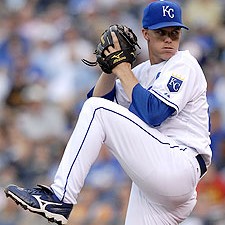
Adam Wainwright will most likely win the National League award, but here, too, I would differ and go with his teammate, Chris Carpenter.
Greinke was terrific this season, at times awesome, no question about it. In many of his games he almost seemed unhittable. He won games on his own. He had to because he pitches for the Kansas City Royals, one of the worst offensive teams in the major leagues. But then, the only worse offensive team is the one Hernandez pitches for, the Seattle Mariners.
But there are those two separate seasons Greinke pitched. In his 21 starts before May 31 and after Aug. 3 the 25-year-old right-hander had a 14-2 record and a 1.30 earned run average. Greinke, however, started 12 games from May 31 through Aug. 3, and the results weren’t as dominant as his 21-start performance.
In that stretch Greinke compiled a 2-6 record and had a 3.84 e.r.a. That’s not Cy Young material, and that’s what voters have to consider along with the results of Greinke’s 21 pre-May 31 and post-Aug. 3 starts and his over-all record: 16-8 and a league-leading 2.16 e.r.a.
In a different kind of separation Greinke pitched five complete games in his first 11 starts, then only one in his next 22 starts. Let’s not hold that against him, though. Hernandez has had only two complete games all season. On the other hand, Hernandez pitched a league-leading seven games without allowing a run in at least seven innings.
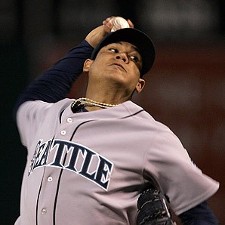
Hernandez, a 23-year-old right-hander, did not survive the season without a “poor” period, but he limited the damage. In four games in May he lost three times, didn’t win once and had a 6.75 e.r.a. That, however, was the extent of his off-peak pitching.
With a scheduled Sunday start against Texas and 17-game winner Scott Feldman remaining, Hernandez had 18 wins (only 5 losses), a .783 winning percentage, a 2.48 e.r.a., a .230 opponents batting average and 211 strikeouts in 232 innings. Those figures all placed in the top four in the A.L., a status unmatched by any other pitcher.
 The Mariners, entering the season finale, had a 24-9 record in Hernandez starts, and Hernandez had a 15-4 record in games he pitched after they had lost. Greinke had a 12-9 record in games following Royals losses, and the Royals had a 17-16 record in all of his starts, basically meaning if he didn’t win, they didn’t win.
Though Hernandez won’t win 20 games, he easily could have, and I’m not talking about the three games in which he left with a lead and the bullpen squandered it. He started 10 games in which he didn’t get a decision, and in those games he had a 2.15 e.r.a. Greinke had 8 no-decisions and a 1.95 e.r.a. in those games.
While Hernandez and Greinke pitched for the league’s weakest offensive teams, CC Sabathia pitched for its most potent. The Yankees are the only team that has scored 900 runs, and their $161 million man was a grateful beneficiary in compiling a 19-8 record.
Sabathia had a chance to become the majors’ only 20-game winner, but the Rays battered him last Friday night in his last start of the regular season, knocking him out in the third inning and raising his e.r.a. to 3.37. Sabathia’s strongest asset in his Cy Young candidacy was the status of a 20-game winner, but he squandered that opportunity.
At an earlier point in the season Roy Halladay of Toronto was a prime candidate for the award. In 15 starts through June he had a 10-1 record with a 2.56 e.r.a. But then J.P. Ricciardi, the Blue Jays’ general manager, told the world that Halladay was available, and his season changed drastically.
In his next 15 starts he had a 5-8 record and a 3.46 e.r.a. The change in his pitching wasn’t a fluke. He wasn’t the same pitcher. In the first 15 starts he allowed 7 home runs. In the next 15 he gave up 15 home runs.
Halladay finished with a 17-10 record and 2.79 e.r.a., third in the A.L. behind Greinke and Hernandez and just ahead of Sabathia.
Justin Verlander, who was scheduled to pitch Detroit’s final game Sunday, has earned consideration with his 18-9 record, his league-leading 264 strikeouts and his position as the heart of the Tigers, but he simply wasn’t as spectacular as Hernandez and Greinke.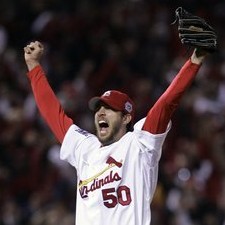
In the National League Adam Wainwright of St. Louis found himself in a position similar to Sabathia, having the opportunity to become a 20-game winner. With the Cardinals leading the Brewers 6-1 after six innings and Sabathia out of his game, Wainwright was nine outs from being No. 1 to No. 20.
But he gave up singles to the first two batters in the seventh, Manager Tony LaRussa yanked him after 90 pitches and the Brewers rallied for 11 runs in two innings.
Winning 20 wasn’t as imperative for Wainwright, a 28-year-old right-hander, in his bid for the N.L. award as it might have been for Sabathia in the A.L. He had many other elements of endorsement, including his league-leading 19 victories and 233 innings pitched and his third-best 2.63 e.r.a.
Wainwright, however, has a teammate, Chris Carpenter, who has some even more impressive credentials. Missing six starts early in the season with a torn oblique muscle, the 34-year-old right-hander has a 17-4 record for an .810 percentage, best in the league, and a league-low 2.24 e.r.a.
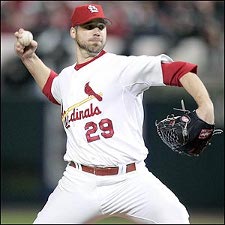 With a little lustier support from St. Louis batters, like the six runs he delivered with a grand slam and a two-run double in his 17th victory, Carpenter could have added two victories in September. He had two successive starts in which he allowed no runs in eight innings and one run in seven innings, yet won neither game. Add victories in those games, and I think he beats out Wainwright.
That leaves Tim Lincecum of San Francisco, last year’s winner of the award, as a legitimate candidate, but some would ask how can he be a legitimate contender with 15 victories. This is how:
He leads the N.L. in strikeouts (for the second straight year) with 261, his 2.48 e.r.a. is second best, his .206 opponents batting average is second and he is tied for first in shutouts (2) and complete games (4). In addition, he emerged from 10 starts with no decision, and in six of those games he gave up two or fewer runs.
In other words, with a little help from his anemic friends, those guys with bats in their hands, Lincecum could have matched his award-winning 18 wins of a year ago.
ERROR METS ON PEREZ OVER WOLF
The Mets needed a starting pitcher. The Yankees, also needing starting pitching, grabbed CC Sabathia and A.J. Burnett for an obscene amount of money, somewhere in the neighborhood of a quarter of a billion dollars. Less expensive starters, though, remained on the free-agent market last winter. Three of them were Derek Lowe, Oliver Perez and Randy Wolf.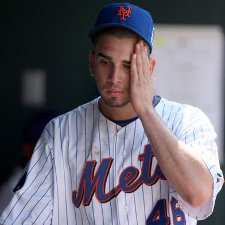
Lowe and Wolf were veterans. Perez was younger but a frustrating work still in progress.
Lowe wanted a multi-year contract (he would get $60 million for four years from the Braves), and the Mets were reluctant to give it to him at his age, 35, to be 36 June 1. Wolf was supposedly a West Coast guy, and anyway at his age, 32, he didn’t seem to have much of an upside.
The Mets’ primary goal was to re-sign Perez, who they felt was one of those late-blooming left-handers. They ignored his constant inconsistency and his inability to throw strikes and agreed to give him a three-year contract for $36 million. Wolf, meanwhile, signed with the Dodgers for one year with a $5 million salary.
One season later, Lowe had a 15-10 record for the Braves and Wolf 11-7 for the Dodgers with a 3.23 e.r.a., a .227 opponents batting average (seventh lowest in the N.L.) and 214 1/3 innings (seventh most) in 34 starts. Perez? Don’t ask. He started 14 games and had a 3-4 record and a 6.82 e.r.a. and walked 58 in 66 innings, walking 5 or more in half of his starts. He had knee surgery Sept. 1 to have scar tissue removed.
It’s impossible to transfer a pitcher’s performance from one team to another and say what he did for one he would’ve done for another. But Wolf would have looked good in the Mets’ terrible rotation.
Arn Tellem, Wolf’s agent, says the left-hander would have willingly signed with the Mets, West Coast reports notwithstanding.
“They could’ve signed Randy,” said Tellem, who recalled that he spoke with general manager Omar Minaya and Jeff Wilpon, the Mets’ chief operating officer, about the pitcher. “He was really interested in New York and excited about the opportunity to come to New York. He was prepared to come if the deal was right.”
Tellem said the Mets’ executives indicated they would sign Wolf if they didn’t sign Perez. They signed Perez. That was their mistake.
COGHLAN IGNITES HITTING FIREWORKS
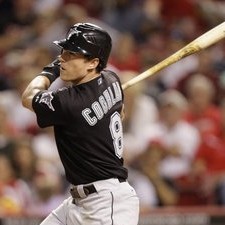 Ichiro Suzuki had a record ninth successive 200-hit season this year. Derek Jeter had his seventh career 200-hit season and broke Lou Gehrig’s 70-year-old record for most hits by a member of the Yankees. But Chris Coghlan might have produced the most remarkable hitting performance of the season.
Coghlan, the Florida Marlins’ rookie left fielder and leadoff hitter, collected the most hits in the majors following the All-Star break. But the 110 hits he had entering the final game of the season were so far ahead of anyone else’s hit production that no one else was in the ball park.
Jeter, with two games left, had 100 hits, and Joe Mauer, with one game to play, had 99. Ryan Braun, with one game to go, was the next closest National Leaguer with 98. Furthermore, Coghlan had 47 hits in September, the most for a rookie since Chuck Klein amassed 50 in 1928.
Coghlan, a 24-year-old left-handed hitter, joined the Marlins May 8 after spending the first month with Class AAA New Orleans. He was hitting .245 at the break but batted .368 during his 110-hit production period, raising his season average to 319.
NO RACES? LOOK AGAIN
In the last few weeks fans, reporters, even baseball people were complaining that there were no races left. First-place teams virtually had their spots locked up, and even the wild-card races had flamed out. How dull for the end of the season. They spoke too soon.
One of the reasons I have loved writing about baseball for nearly 50 years is the developments that can arise as the season nears an end. This past weekend was a perfect example.
Two first-place teams went into the weekend in danger of losing their positions, the Tigers leading the Twins by two games and the Dodgers ahead of the Rockies by two and, better yet, playing them in the last three games of the season.
After Friday night’s games, the Tigers’ and the Dodgers’ leads were down to one game. The teams were going into the next-to-last game of the season in great peril. Both teams had been on top of their divisions seemingly forever, and now they were in danger of collapsing.
The Dodgers, who were assured a playoff spot win or lose, as were the Rockies, survived by beating Colorado Saturday night. However, the Tigers, who had no safety net, lost while the Twins won, sending the American League Central race to the last day.
Could any other sport provide this kind of drama, this sort of fun? Not as far as I am concerned.
