These were the standings of the top four teams in the National League Central after games of July 22: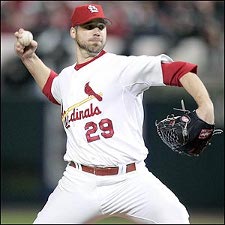
|
W |
L |
GB |
|
| St. Louis |
51 |
46 |
— |
| Chicago |
48 |
45 |
1 |
| Houston |
49 |
46 |
1 |
| Milwaukee |
48 |
47 |
2 |
With the teams bunched so closely, it promised to be one of the most scintillating, intriguing races in recent seasons. By last Saturday, however, this was the snapshot of that race updated:
|
W |
L |
GB |
|
| St. Louis |
75 |
55 |
— |
| Chicago |
64 |
62 |
9 |
| Houston |
62 |
66 |
12 |
| Milwaukee |
62 |
66 |
12 |
What happened to the race? Just like that, it evaporated. While the Cardinals won 24 of 33 games, the Cubs lost 17 of 34, the Brewers 19 of 33 and the Astros 20 of 33. The Cardinals weren’t even supposed to contend for a spot in the playoffs, but here they are running away from the other contestants in the division race.
The Cubs, on the other hand, were supposed to be a contender, if not the division winner. But the Cubs have been one of the most disappointing teams in the major leagues this season, perhaps the most disappointing because the Mets had a ridiculous run of injuries, which was still rampant last week.
The Cubs were very much in the race when the calendar turned to August. In fact, they led the race for four days in the first week of the month, standing two percentage points ahead of the Cardinals after games of Aug. 6. Since then, though, the Cubs lost 13 of 20 games while the Cardinals won 16 of 20.
It was during that 20-game stretch that the St. Louis starting pitchers showed off their talent. Chris Carpenter (above), Joel Pineiro and Adam Wainwright combined for an 11-0 record, Carpenter and Pineiro each winning four games and Wainwright three.
 With all due respect to Albert Pujols, those pitchers form the foundation of the Cardinals’ challenge for another World Series championship. But to give Pujols his due, entering Saturday’s games, he was leading the league in home runs (41), runs scored (100), total bases (299), slugging (.666) and on-base (.440) percentages, extra-base hits (74) and grand slams (5). He was only third in runs batted in (108) and tied for fifth in hitting (.316).
Wainwright leads the league with 15 victories, but Carpenter, despite missing six early-season starts with a strained oblique, has won 14 times and has the league’s lowest earned run average, 2.20. Wainwright’s 2.50 is fourth lowest. Pineiro, who last season had a 5.15 e.r.a., has a 3.11 e.r.a. to go with his 13-9 record.
Last winter the Cardinals wanted to trade Pineiro, but his 35-47 record in the previous five seasons and his $7.5 million salary for this season discouraged prospective employers.
This month the Cardinals’ starting rotation got an unexpected boost when John Smoltz became available after he bombed in Boston. In eight starts for the Red Sox, the 42-year-old Smoltz compiled a 2-5 record and 8.33 e.r.a. and was released. He has started two games for the Cardinals, who won both, allowing one run in 11 innings.
The Cardinals similarly boosted their offense with in-season acquisitions. Left fielder Matt Holliday hit .380 and drove in 29 runs in his first 32 games. Julio Lugo batted .302 in 28 games and Mark DeRosa hit 8 home runs in 41 games.
The Cubs, meanwhile, have staggered along, headed for a finish below first place for the first time in three years. Look no further than the team’s impotent offense to find the reason.
Last season the Cubs led the league in scoring, averaging 5.3 runs a game. This season they have averaged nearly 1 run less, 4.4.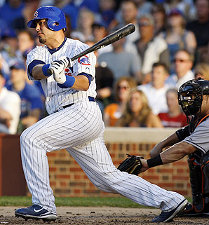
Rather than looking at a team’s hitters underperforming, some baseball people believe the Cubs’ hitters overperformed last year. One of those was the N.L. rookie of the year, Geovany Soto (right), who batted .285, which was higher than he ever hit in the minors. This season he’s hitting .215. He also has hit 9 home runs and knocked in 31 runs where last year he slugged 23 homers and drove in 86 runs.
Last tear Mike Fontenot hit .305; this year he’s hitting .226. Alfonso Soriano, whose production has fallen since his earlier seasons in New York and Texas, is hitting .243 with 20 homers and 55 r.b.i. in 115 games. Last year he batted .280 with 29 homers and 75 r.b.i. in only 109 games.
Pitchers, too, have suffered a dropoff. Ryan Dempster has gone from 17-6 to 7-7 (his e.r.a. has risen from 2.96 to 4.07), and Carlos Zambrano has slipped from 14-6 to 7-5.
Jim Hendry, the Cubs’ general manager, did not return a call intended to discuss his team’s plight. I understand that. If I were the Cubs’ general manager, I wouldn’t want to discuss them either.
The Cubs have had company in their fall from the race. The Astros have had a peculiar season. They spent most of the first month in last place, then divided the next two months between sixth and fifth. But they were never so far from first that they couldn’t conceive of contending for the top spot.
At the All-Star break they were only 3 ½ games from first, and a week after the break they were only 1 game out. They arrived at that juncture by sweeping a three-game series from St. Louis. From there, though, it was all downhill.
The Brewers showed more signs of being a contender than the Astros, sitting in first place for most of a seven-week period from May 13 to July 3. But they reached the apex of their season June 17 when they were 8 games over .500 at 37-29 and slipped steadily from there. Doug Melvin attributed the Brewers’ decline and fall to their lack of pitching.
 “Last year we had CC and Ben Sheets for 48 starts,” the general manager said, referring to CC Sabathia. “The combined e.r.a. of the two of them was 2.5 over those 48 starts. I was hoping early in the year we could get by hoping that Gallardo could do what Sheets did.”
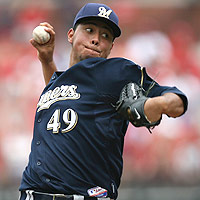
But Yovani Gallardo (left) has not been up to the task, pitching decently with a 12-10 record and 3.51 e.r.a. but not well enough to overcome the loss of Sabathia or Sheets. In assessing Gallardo, though, Melvin noted that he has had eight starts in which the Brewers didn’t score a run for him. One of the eight was an April game against Pittsburgh in which Gallardo hit a home run for the only run of the game.
“It was hard replacing those two guys,” Melvin said. “They combined for more than 300 innings. Both would go deep in games and that’s what we haven’t gotten.”
Melvin added a starter, signing Braden Looper as a free agent, but came up empty in his quest to trade for another starter. He tried to get Edwin Jackson but balked at the Rays’ asking price, and the Cubs wouldn’t trade Jason Marquis within the division.
The Cardinals, meanwhile, added their own starter. “The difference,” Melvin said, “is the Cardinals have Carpenter and they didn’t get one start out of him last year.”
A MAN WITH HEART
 It’s easy to like Aaron Boone, and that’s why I, among many others, am delighted that he is back playing baseball five months after heart surgery.
Boone, 36, has rejoined the Houston Astros and will be on their active roster when rosters can grow to 40 players Tuesday.
“I feel good; I’m excited,” the third baseman said last week in between rehabilitation games.
Boone had surgery last March to correct a congenital heart defect, an aortic valve replacement. When I spoke with him a few days before the operation, he wasn’t certain that he would be able to play baseball again, let alone this season. However, based on my experience with heart surgery, I told him I thought he would be back.
Hal McCoy, who is retiring from active baseball coverage after covering the Cincinnati Reds for 37 years, is another baseball writer who is a Boone fan. In spring training of 2003 McCoy planned to retire after developing a serious eye ailment that affected his ability to see games, but Boone talked him out of it and encouraged him not to give in to the ailment.
Another reason to like Boone: When he suffered a knee injury in January 2004 season, he told the Yankees the truth, that he hurt the knee playing basketball, violating terms of his contract. Had he concocted a tale, which players usually do in such situations, he might have saved his entire $5.75 million salary instead of forfeiting most of it.
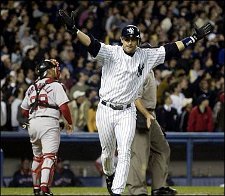
Only three months earlier Boone had gained a special place in Yankees history by hitting a pennant-winning home run in the 11th inning of Game 7 of the American League Championship Series against Boston.
When Boone was on the verge of joining the Astros, he said, “I feel good about where I am. I’ve been playing a couple weeks. The last week or so I’ve felt normal.”
There was a questionable moment before that. “About two weeks after I got home from the surgery,” Boone related, “I went into ‘a’ flutter. I had to go back in the hospital for a couple nights. They were going to do a procedure, but they didn’t have to. I went back into the right rhythm.”
SOME TRADES ARE BEST FORGOTTEN
 The trade the Mets made the day before the trading deadline of the 2004 season did not produce a pennant. It didn’t even get the Mets out of fourth place. They were in fourth place when they made the trade, they were in fourth place at the end of the season and they were in fourth place every day in between.
The only difference in their status was they went from three games under .500 to 20 games under .500 and they went from 6 games behind Atlanta to 25 games behind.
Today, though, it cannot be said that the Mets are the only team that traded Scott Kazmir.
The Tampa Bay Rays, the team the Mets traded Kazmir to the day before the trading deadline in 2004, traded the pitcher to the Angels of Anaheim last week. The Rays received two minor leaguers and shed $23.68 million of Kazmir’s $28.5 million contract.
When the Mets traded the left-handed pitcher to the Rays, they received two pitchers, starter Victor Zambrano and reliever Bartolome Fortunato. Zambrano was a disaster for the Mets, who were severely criticized for the trade by fans, people in baseball and the news media.
Zambrano, the key to the deal for the Mets, started 35 games for them over the next two and a third seasons and compiled a 10-14 record. He last pitched in the majors in 2007.
THE EPITOME OF PITCHING FUTILITY
Adam Eaton deserves credit for trying, but his survival in Major League Baseball just shows how poor the pitching is and how desperate teams are to find pitchers who can get batters out. The Philadelphia Phillies were so desperate in November 2006 that they gave Eaton a 3-year, $24.51 million contract.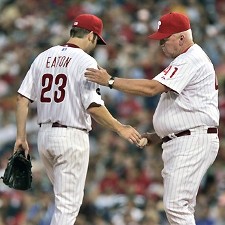
Eaton has been released twice this year, by the Phillies in spring training and by Baltimore May 22, but the Colorado Rockies signed him to a minor league contract June 6 and summoned him to the majors Aug. 12 to work out of the bullpen.
A 31-year-old right-hander, Eaton has not had a season earned run average under 5.00 since 2005.
| 2006 | Texas |
5.12 |
| 2007 | Philadelphia |
6.29 |
| 2008 | Philadelphia |
5.80 |
| 2009 | Baltimore |
8.56 |
| Colorado |
5.63 |
On Aug. 24 Eaton was called in to pitch the 14th inning and maybe longer, if necessary, against San Francisco. The game was tied, 1-1.
Two of the first four batters Eaton faced in his fourth relief appearance for the Rockies lashed triples, and the Giants grabbed a 4-1 lead. But that was not to be Eaton’s last contribution to the outcome of the game.
In the Rockies’ half of the 14th, Eaton batted against Justin Miller with the bases loaded and one out and walked, forcing in a run. The next batter, Ryan Spilborghs, whacked a grand slam against Merkin Valdez, and Eaton became the winning pitcher.
Neither that technicality nor Eaton’s ability to draw a walk in a critical situation saved Eaton. The next day the Rockies sent him to the minors.
Will he be back? Who knows? Pitchers have more lives than cats. If Eaton doesn’t make it back, though, he will have left a legacy.
On Jan. 4, 2006, Eaton went from San Diego to Texas in a six-player trade. One of the three players who went to the Padres was Adrian Gonzalez, who has become one of the most fearsome hitters in the National League.
REPORT RUMOR, IGNORE FACTS
 I suppose there’s no such thing as a responsible rumor so I shouldn’t be surprised to see irresponsible rumor in the rumor rundown column on ESPN.com.
In an item about a report that Fred Wilpon would be forced to sell the New York Mets because he had lost $700 million to his old and dear friend Bernie Madoff, ESPN identified the source of the rumor, a woman who has written a Madoff book, and quoted her as saying it was certain that Wilpon would sell.
ESPN quoted a Mets statement that the amount mentioned was inaccurate, then said that Wilpon had talked to The New York Times about how the Mets were an “emotional asset” to his family.
But the ESPN rumor rundown item ignored the part of the Times article that quoted Wilpon as saying he was not selling the Mets. I suppose that little piece of information would have undermined the rumor, and what’s a rumor rundown column without good rumors?
RETIRE? WHO, ME?
In a column last week about the pending extinction of the Sports of the Times column in The New York Times, I quoted the article in the New York Observer that disclosed the plan as saying that George Vecsey, one of the Times columnists, “told the Observer that at age 70, ‘he’s about ready to retire.'”
Vecsey, in an e-mail, said he told the Observer no such thing. He never told anyone he was retiring, Vecsey wrote. “Because I am not” he added. “I like what I do.”
John Koblin of the Observer, Vecsey said, “asked me how long I planned to work and I said something like, ‘Let’s put it this way: I don’t think I’ll be doing this a decade from now.'” He added in his e-mail, “I also told him, as long as I can walk faster than people half my age going up the stairs from the clubhouse to the press box that I would keep working.”
I asked Koblin about the matter, and he responded, “I asked George how many years he had left as a columnist. He replied, ‘Not too many.’ He went on to explain, as I quoted him, that it’s a young person’s business and that he wouldn’t want to get old in the job. George is 70. I took that to imply that he was about ready to retire. If George is saying to you that he’s going to be doing this for a while then that’s great news for all of us.”
