Archive for June, 2014

THE REINO IN THE ROOM

Sunday, June 8th, 2014

At the age of 78, Jerry Reinsdorf very likely doesn’t have a lot of time left as chairman of the Chicago White Sox and an influential owner in Major League Baseball. That means if he has any unfinished business, if he wants to accomplish something dear to him while he has time, he has to act quickly. And boy does he have something he wants to accomplish.

He doesn’t talk about it, but his actions betray his silence. Despite the battering the owners took in the 1994-95 strike and the severe damage it did to Major League Baseball, Reinsdorf apparently wants to revisit the issue that the owners fought the players over in 1994 and ’95.Jerry Reinsdorf 225
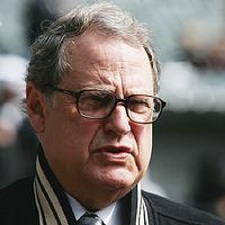
Curious about Reinsdorf’s reported opposition to Bud Selig’s desire to have Rob Manfred, MLB’s chief operating officer, succeed him as commissioner when he retires next January, I asked several people why they thought Reinsdorf opposed Manfred.

“This is all about Jerry,” said a lawyer who is closely connected to Major League Baseball and many of its owners. “He wants to protect his own power. He floated an idea of not having a commissioner but a three-man panel, which would include him. Or he should be interim commissioner like Bud was.”

Reinsdorf, through a White Sox spokesman, has denied that he proposed or favors those ideas. But either idea would enable Reinsdorf to remain in a position of power or influence, which he has enjoyed in Selig’s 22 years as commissioner.

However, for Reinsdorf to achieve what he wants he has to undermine what his buddy wants, no less at the expense of Selig’s legacy, which Selig cherishes above all else as he eases into retirement. Why does Reinsdorf oppose Manfred?

“He thinks Rob isn’t tough enough in labor,” the lawyer said. “He feels the union can be made to accept a salary cap.”

Baseball personnel and fans should find that thought probably the most frightening anyone could suggest for baseball. The owners’ attempt to gain a cap in 1994 produced the disastrous strike and cancellation of the World Series and left the game wobbling for a couple of years.

Selig, who with Reinsdorf led the ill-conceived charge for a cap on payrolls, has at least acknowledged that he learned from the debacle. Reinsdorf obviously cannot echo that statement; nor apparently does he want to.

Reinsdorf remains stuck in the payroll cap rut. Having won a World Series championship in 2005, what is left undone for Reinsdorf? Ignoring the danger that he may be creating the baseball version of “Groundhog Day,” he wants to revisit history, rewrite it and emerge with a different ending. He is the worst kind of loser.

What bothers me, though, is if he really sees an opening, I can understand his thinking.

The union is not the same union Selig and Reinsdorf confronted in 1994 after forcing Fay Vincent out as commissioner. In Reinsdorf’s thinking, Manfred would be the new Vincent, a commissioner who would stand in the way of the militant owners’ desire to force the union into submission.

Tony Clark 225Reinsdorf and a few other militant owners see the union in a weakened position. Its executive director, Tony Clark, and the general counsel, David Prouty, have no strike or lockout experience. As a player, Clark was a union member, but he began his major league career in September 1995, after baseball’s last work stoppage.

Because the union and the clubs have negotiated three consecutive labor contracts without a work stoppage, the players have no strike experience. In addition, they make so much money, the militant owners figure, they won’t want to strike and give it up.

Clark has acknowledged that one of his biggest and toughest jobs will be to educate the players, but he is confident he will be able to do what needs to be done. In addition, Clark is the union’s first executive director with no previous labor experience.

Manfred, who had developed a good relationship with Michael Weiner, the union leader, who died last November, is in a curious position. As the owners’ chief labor executive, he has been largely responsible for the unprecedented two decades of labor peace that Selig justifiably likes to herald.

Reinsdorf, however, apparently doesn’t see that development as a Manfred strength. He hasn’t declared this publicly, but in his view Manfred’s ability to negotiate successfully with the union must mean he has become too close and too soft with the union.

Manfred, Reinsdorf has seemingly concluded, is not the man to lead the owners into a war over a payroll cap nor would he have the stomach or the desire to play that role.

Does Reinsdorf have a candidate?

“First he tried Brosnan and that’s not going to happen,” said a high-ranking baseball executive. Tim Brosnan is MLB’s executive vice president for business. Reinsdorf’s latest candidate?

“He’s the guy promoting Iger,” the executive said.

That would be Robert Iger, head of the Walt Disney Company. A few weeks ago the New York Post’s Page Six led the gossip page with an “exclusive” report that Iger “could be next MLB commissioner.” Iger, the report said, “is a favorite of the league’s succession committee.”

It also said that to be elected a candidate will need votes from 24 of the 30 owners. If the Post’s reporting is as good as its math (the required 75 percent is 23 votes, not 24), Iger won’t be getting the job.

The Post, however wasn’t the only newspaper promoting Reinsdorf’s candidate. A few days later The New York Times reported that “Disney executive gains supporters.”

Iger, however, has a problem even before he is nominated. His contract with Disney runs through June 30, 2016; Selig’s contract expires Jan. 24, 2015. It wouldn’t surprise me, though, if that time gap played into Reinsdorf’s thinking in promoting Iger.Bob Iger, president and CEO-elect of The Walt Disney Co.
If the owners wanted Iger to succeed Selig, they could elect him effective the day he leaves Disney. In the 17-month gap, in Reinsdorf’s ideal thinking, Reinsdorf could serve as interim commissioner.

The timing would be perfect for Reinsdorf’s plan. The basic agreement expires Dec. 1, 2016, meaning negotiations would begin before Iger would take office and while the interim commissioner was calling the shots. What a potential disaster that would be.

It was after the last labor dispute that Reinsdorf demonstrated his style of operation. It’s not one for all and all for one, as the Three Musketeers practice, but one for one, and only one.

The players had struck for 234 days, Selig called off the 1994 World Series and it took a federal court injunction, issued by Judge Sonia Sotomayor, now a justice of the United States Supreme Court, to induce the players to return to work.

The owners and the players still had to negotiate an agreement, and Randy Levine for the owners and Donald Fehr for the players accomplished that shortly after the 1996 World Series. The owners, though, rejected the agreement by an 18-12 vote at a meeting Nov. 6.

Three weeks later, at another meeting Nov. 26, the same owners approved the agreement by a 26-4 vote. In between those meetings, Reinsdorf enraged his fellow owners by signing free-agent Albert Belle to what was then a record 5-year, $55 million contract.

Here was the owner most vehemently pushing for a payroll cap, and he was signing a player to a record contract. There was some thought at the time that he did it out of spite for the owners who opposed his position. Whatever his reason, Reinsdorf incurred great wrath among other clubs:

Andy MacPhail, Cubs, on their Sammy Sosa contract: ”We weren’t interested in any five- or six-year contract. We were willing to make a concession on the average annual value to keep it four.”

Dave Dombrowski, Tigers, on their Gary Sheffield signing: “It had a tremendous impact; there’s no question. They didn’t want to talk at all until Belle signed. Once the Belle numbers came in, they were very open to talk. I said this might be an aberration. Then the Bonds numbers came in and the market was defined. So it had a tremendous impact.”

Doug Melvin, Rangers, on their Ivan Rodriguez contract: “The whole negotiation was ‘if Belle, Sheffield and Sosa can get $10 million,’ That’s what we were faced with.”

Reinsdorf’s response? ‘We’re not being fiscally irresponsible because we can afford it.” He also was quoted as saying, ”Actually, it’s good for the White Sox because it dooms the small-market teams. There will be less for us to compete against.”

This is the man who wants to go to war with the union – again?

This is the man who wants to be in control of Major League Baseball?

“This is shocking,” said one of the people I talked to about the Reinsdorf initiative. “Bud is upset.”

Selig has reason to be. He likes things to run smoothly to the extent that he always knows what the outcome of an owners’ vote will be before he conducts the vote.

“I think Rob has the votes,” said the lawyer who spoke earlier. “All the teams like Rob and respect him.” The Reinsdorf group, he added, doesn’t have the eight votes needed to block a candidate’s election.

.500 OR BUST

Not all teams have won-loss records of .500 or close to it. It just seems that way. At the start of the week (Sunday morning) the Indians and the Rangers were at .500; the Yankees, the Cardinals and the Dodgers were one game over .500, the White Sox were one game under .500; the Orioles, the Nationals and the Marlins were two games over .500 and the Royals and the Twins were two games short of .500.

Looking at the entire season, according to Elias Sports Bureau, teams have had .500 records 191 times. In the equivalent time last season, teams had .500 records 100 times.

MATTINGLY NEEDS CHEMISTRY COURSE

Jim Frey had the best observation I ever heard on team chemistry.

“Give me a three-run homer,” said Frey, who managed the Royals and the Cubs in the 1980s, “and I’ll show you good team chemistry.”
Don Mattingly 225The subject came up last week when Don Mattingly mentioned it in an interview with ESPNLosAngeles.com. “Don Mattingly: Chemistry at issue,” the headline read.

The Dodgers began Sunday’s game at Colorado only one game over .500 (32-31) and the largest second-place deficit (9 ½ games) in the majors, not a pretty picture for a team with a $235 million payroll, highest ever in the majors.

“It may be a day here or a day there, but it hasn’t felt like a true team at this point….,” the Dodgers’ manager said.

I have never been sold on Mattingly as a manager. That he is the manager of the Dodgers is due to Joe Torre. When Joe Girardi (on whom I am sold as a manager) beat out Mattingly for the Yankees’ job, the former first baseman joined Torre in Los Angeles. He was there when Torre retired, and the Dodgers made him their manager even though he had never managed anywhere.

In the interview last week, Mattingly blamed a lack of cohesion for the Dodgers’ troubles. But isn’t it the manager’s responsibility to turn his team into a cohesive unit? Isn’t it the general manager’s responsibility to get players who fit with each other and form a cohesive unit with good team chemistry?

Certainly there are instances where selfish players undermine cohesiveness. The ESPN article cited one such case with the Dodgers. Matt Kemp is reportedly unhappy that he had to take his $160 million contract to left field when he had always played center.

This sort of problem can be viewed in two ways: either Kemp is being paid so abundantly that he should happily move if asked, or his contract gives him the status to reject a move.

My first experience with that kind of situation was in 1974 when Bill Virdon became the Yankees’ manager and switched Bobby Murcer to right field and put Elliott Maddox in center.

Virdon, who had been an outstanding center fielder himself, was clearly right in his judgment of Murcer and Maddox, but Murcer was the Yankees’ star at the time and was insulted at being made to move out of center, where the Yankees had touted him as being next in the line of Joe DiMaggio and Mickey Mantle.

Murcer never forgave Virdon during his playing career, but the manager actually did him a favor because he was better suited to right and wasn’t subjected to criticism for mistakes he might have made in center.
HOME RUNS (DO NOT) EQUAL DIVISION LEADERSHIP?

Thursday, June 5th, 2014

The American League’s three division leaders met for a series of round-robin games over the last two weeks, with Oakland, Detroit, and Toronto looking to establish early-season supremacy in the Junior Circuit. The Athletics and Tigers split a four-game series in Detroit, and it has been the surprise division leader—the Blue Jays—sweeping the potential playoff previews.

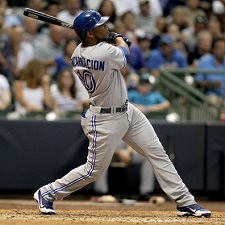
League-leading Oakland was up first. The A’s flew to Toronto in late May having won 11 of 13 games in the previous two weeks, generating a healthy amount of “Moneyball 2.0” buzz along the way. In the second inning of the series, Toronto’s fill-in second baseman, journeyman Steven Tolleson, jumped on a 3-1 Scott Kazmir offering for a two-run home run, his first of the year, and the Blue Jays never trailed in the game. Tolleson had hit just three career homers entering this season, but Toronto’s early-season home run binge is affecting all members of the lineup.Edwin Encarnacion 225

Evidence came the next day, when infielder Brett Lawrie, whose career high in home runs entering 2014 was just 11, hit his eighth of the year to break a 1-1 tie; again, Toronto never trailed after its home run en route to another victory over Oakland. To round out the sweep the Blue Jays relied on another homer, with first baseman Edwin Encarnacion blasting his 14th home run of the year to open the scoring and, once again, give the home team a lead it wouldn’t relinquish. Encarnacion added two more homers in May, giving him 16 for the month to tie an American League record.

The Jays weren’t done. In Detroit this week, Toronto has continued homering and winning in the same breath. Lawrie slugged his ninth of the year, a three-run blast, in a two-run win Tuesday night, and Melky Cabrera matched Lawrie with his ninth to give Toronto the lead Wednesday before Detroit had the chance to bat.

The Red Sox are the defending World Series champions. The Rays have won 90-plus games in four straight years. The Yankees spent the winter revamping their roster with a nearly-$500 million spending spree. The Orioles boast a lineup with five All-Stars. Those four teams each won at least 85 games last year, and they all received multiple votes to win the division in ESPN’s 2014 preseason preview.

Of the 44 ESPN staffers who made preseason predictions, though, not a single one picked the Blue Jays to win the AL East, and only one selected Toronto as a wild-card team. Maybe they were scared off after 2013, when 20 members of ESPN’s team forecast the Blue Jays as the division champion only to see Toronto flounder to 74 wins and a last-place finish.

It has been a lean two decades for Toronto baseball since the team won consecutive World Series titles in 1992 and 1993. The Blue Jays haven’t qualified for the playoffs or won 90 games in a season since, and only in 2006 did they even finish in second place in their competitive division. Heading into 2014, they had gone six straight years finishing in fourth or fifth place.

But after compiling a league-leading 21-9 mark this May—tied for the most wins in a month in franchise history—the Blue Jays sit a comfortable 4.5 games clear of second place. Toronto’s 34-24 record after two months was the team’s best since 1993, a season that ended with Joe Carter touching ’em all.

Fitting when reminiscing about Joe Carter, the most-discussed stat for the Blue Jays’ offense has been its home run output. Toronto’s 83 home runs lead the league by a wide margin, and both Encarnacion (19) and Jose Bautista (14) rank in the top 10 in the majors. Nine players in the AL East have blasted eight or more home runs this year, and six play for Toronto; no other AL team has more than three players with as many homers.

The Jays’ offense is simply one of the best in baseball, particularly with regard to power numbers. Of the team’s nine players with at least 100 plate appearances, eight are slugging .400 or better (the AL average is .394). Not only does the team lead the league in home runs but it ranks first or second in total runs, hits, on-base percentage, and slugging percentage.

After the team’s disappointment a year ago following its offseason trading bonanza, there’s reason for excitement in the Rogers Centre. Coupled with inconsistent starts for Toronto’s division opponents—or, in the case of Tampa Bay, a consistently awful start—fans have to be optimistic about the team’s chances for bringing postseason baseball to Canada for the first time in 21 years.

Accompanying this optimism in several corners of the Internet is another fact: four of the last six teams to have led the league in home runs have won their respective divisions. This argument seemed specious at first, a flukish streak and the product of small sample size. After all, I started watching baseball during the height of the Steroid Era, when balls flew into the stratosphere above Arlington and Denver only for those homer-happy home teams to miss the playoffs. Does hitting more home runs really correlate with playoff appearances?

Since the expansion to three divisions and the addition of the original wild card, the answer to that query is decidedly mixed. While the fact that spurred my research is correct—four of the past six teams to lead the league have indeed won their divisions—it’s a bit misleading. One of those teams, the 2008 White Sox, were hardly a juggernaut, winning just 88 games in a weak division and requiring a tiebreaker victory over the Twins to advance to the postseason. The other three were all Yankees, with the 2009, 2011, and 2012 versions of the Bronx Bombers living up to their moniker and leading the league in both home runs and the AL East in wins.

Before 2008, though, teams that won the home run title fared much worse in the standings. The last non-Yankee team to win its division outright while also leading the league in home runs was the 1997 Seattle Mariners—or about 600 homers, one-season-long suspension, and $350 million ago for Alex Rodriguez, that Seattle squad’s young shortstop. It has been nearly two decades since a non-Yankee team led the league in homers and won more than 90 games (the 1995 Cleveland Indians).

In fact, taking into consideration only the non-Yankee home run leaders in that time yields a rather unimpressive result: an average record of 81-81, with just two division winners among 15 teams. From 1998-2003, it was particularly bad: no team that led the league in home runs managed even a .500 record or finished within 10 games of the division winner.

Zach Chart (2014-06-05)

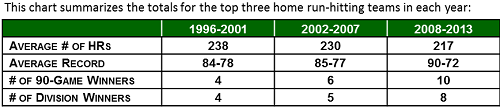
My initial suspicions were correct, then: the recent trend appears to be nothing more than small sample size. But there’s another way to tell this story, and that comes when we expand the calculations a bit. Instead of focusing on just the leader, let’s take a look at the top three home run hitting teams per year. When we do, a more concrete pattern starts to emerge.

In the six-year stretch from 1996-2001, only four of the 18 teams that finished in the top three in home runs in a year won 90 games, and only four won their division. Homer-happy teams fared a little better from 2002-2007, with six winning 90 games and five winning the division.

The jump in success started six years ago; since 2008, more than half of the teams to finish top 3 in homers won 90 games, and eight won their division. And only last year’s Mariners, who improbably ranked second in home runs despite winning only 71 games, have performed so well in the home run rankings and finished with a losing record.

The explanation for these findings is quite murky. The first suggestion that jumps out is that with home runs down league-wide since the end of the Steroid Era, teams that still have power bats throughout the lineup should stand out more from their competition. But there is no noticeable or consistent trend in the difference between the number of home runs hit by the top team (or top three teams) and the MLB team average in any given year. Rather, as the average has generally trended negatively in the last decade, so has the average for the home run leaders. Splitting the past 18 years into those same six-season segments, the average for the top three home-run hitting teams has decreased from 238 (1996-2001) to 230 (2002-07) to just 217 (2008-13).

There have been outliers every few years, of course—teams that performed far better than average—but even those high-scoring outfits struggled in the standings: the highest single-season home run totals since the turn of the century belong to the 2005 Rangers (260), 2010 Blue Jays (257), and 2000 Astros (249), all of whom missed the playoffs.

Perhaps the explanation is that home runs can act simply as a stand-in for total runs, but this logic does not hold up either. Since 1996, teams that have finished in the top three in home runs in a year have consistently ranked an average of sixth in total runs; in other words, there is no indication that hitting more home runs correlates with higher run production now that homers—and overall runs—are declining.

The explanation might elude discovery, but the trend itself—that in the last six years, teams that perform better in the home run rankings have performed better in the win-loss ledger—only appears when examining the numbers through a very specific set of parameters. We simply need more data to arrive at firmer conclusions, so any writer jumping to cite the Jays as likely division winners because of the last six seasons should hold off on making any such proclamation.

Even this year, the results are mixed: of the top home run-hitting teams, the Blue Jays, A’s, and Giants are all division leaders whereas the Rockies (second in home runs) started strong but have fallen back below .500 in winning just two of their last 10 games.

If there’s any lesson to be taken from the last 18 years of data, it is that continuing to lead the league in home runs will be a byproduct, not a cause or marker, of Toronto’s offensive prowess. So, Blue Jays fans, don’t grow too excited that your team is leading the league in home runs, lest it repeat its 2010 result. That year, the Blue Jays hit 103 more home runs than the average MLB team—the highest difference in the last two decades—but finished just 85-77, 11 games back in a distant fourth place. This year, at least 85 wins might be enough to take the AL East crown.

Or teams should just try to emulate the 2000s-era Yankees for regular-season success. That would probably work, too.

COULD POLANCO PULL A PUIG?

Sunday, June 1st, 2014

On a Pittsburgh radio show recently, the host, Sam Reich, asked Frank Coonelly, the Pirates’ president, why Gregory Polanco hadn’t been promoted to the major leagues, considering that he was tearing up the International League with his bat and the Pirates’ bats were anemic.Gregory Polanco 225

“The official line,” Reich told me Friday, “is it’s not a matter of finances; it’s a matter of experience and development. Huntington said pretty much the same line.”

Neal Huntington is the Pirates’ general manager, and it’s not surprising that the general manager and the president would spout the same party line. I tried, with multiple calls to each, to contact both Coonelly and Huntington, for comment on that party line, but neither returned the calls. So let’s explore the Pirates’ party line on our own.

This exploration takes place at an appropriate time, when clubs begin bringing up their good young players from the minor leagues. The promotion migration occurs every season around this time, with an influx of prospects who have been kept in the minors while the parent teams are manipulating their service time and delaying their eligibility for salary arbitration and free agency.

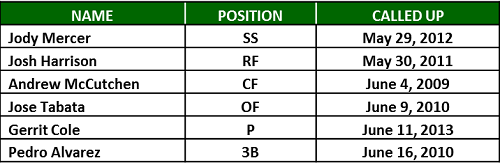
Let’s begin our scrutiny with this list of Pirates and the dates they were summoned to the majors:

Pirates (2014-06-01)large

It is a remarkable coincidence that these half-dozen players gained enough experience and met the Pirates’ development requirement in time to be called up in the same three-week period in five different seasons. The Pirates have established a pattern that suggests that Polanco will arrive at beautiful PNC Park in the next couple of weeks. What better evidence could we have?

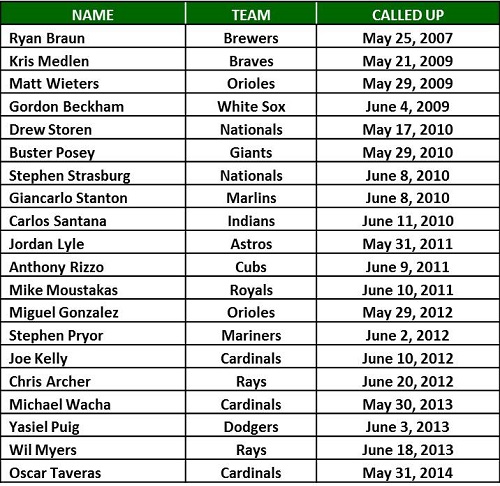
The Pirates and their players, though, are not unique. Consider these players from other teams and their call-up dates from 2007 to this year:

CallUps (2014-06-01)large

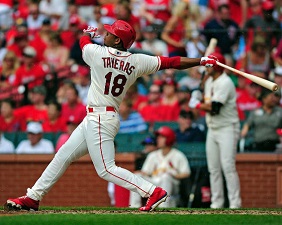
The Cardinals called up Taveras Saturday only because of an injury to first baseman Matt Adams. The rookie instantly demonstrated his value. Starting at first base Saturday night against the Giants, he hit a home run in the Cardinals’ 2-0 victory.

The Cardinals would very likely have made that move anyway because the 21-year-old Dominican was obviously ready, but this was most likely a couple of weeks earlier than they would have preferred.

The Cardinals, however, couldn’t help but rave about Taveras in their news release announcing his promotion. He was, they said, leading Class AAA Memphis in hitting with a .325 batting average, had driven in 40 runs in 49 games and was hitting .479 with runners in scoring position.

In addition, the Cardinals said, Baseball America rated Taveras their top prospect each of the past two seasons. What the release didn’t say was why they hadn’t called him up earlier. I suspect he needed additional experience and development.

That line is the one Coonelly and his fellow management lawyers wrote when he was in the commissioner’s office. All of the clubs use it: This player (fill in the name) needs more experience and development before we can call him up to play in the majors.

The clubs are so arrogant they expect everyone to swallow that line. They think that no one notices that all of these delayed players reach the acceptable intersection of experience and development around the same time.

Unfortunately for the players, there apparently is nothing illegal about the practice. The clubs, though, must have trouble accepting that because they lie about the reason for the delayed call-ups. Yes, I am saying Coonelly is lying when he says the reason Polanco remains in the minors is he needs more experience and development. If the Pirates were trying to turn the good-hitting, good-fielding outfielder into a ballet dancer, maybe he would need more lessons, but baseball is his game and he plays it extremely well.

In the latest International League statistics, Polanco was leading the league with a .348 batting average, 45 r.b.i. in 53 games and .556 slugging and .411 on-base percentages. He was tied for the lead in home runs with 6 and also had 15 doubles and 5 triples.

That Coonelly, when talking about Polanco, can say “experience and development” with a straight face is a testament to his acting ability. If in their place he said salary arbitration and free agency he would get higher grades for honesty and candor.

But most club officials can’t bring themselves to admit that money is the reason they deprive their fans of the Puigs and Polancos.

The union constantly scrutinizes the call-ups and waits patiently before filing a grievance, challenging the clubs’ practice. “It’s legal but questionable,” a labor lawyer said.

“We’re watching it,” David Prouty, the union’s general counsel, said. “We’re aware of several cases and we’re weighing our options.”

The clubs say an arbitration decision gives them the right to decide when to call up players. “I know they think that,” Prouty said. But Dan Halem, MLB’s executive vice president for labor relations, acknowledged that “we’ve never had a head-on case where the issue was ‘you delayed in bringing me up to affect my service time.’”

Halem said he would have his office look into the basis for the clubs’ stance, but no one from the labor relations department called before the weekend with information.

Prouty said he believed the clubs based their position on a 1986 case in which Dennis Lamp, a Toronto relief pitcher, filed a grievance against the Blue Jays, contending they stopped using him in September to avoid having a 1987 salary become guaranteed. The arbitrator, George Nicolau, ruled for the Blue Jays.

“The arbitrator said he wasn’t going to presume to tell a manager when to use a player,” Prouty said. The clubs apparently translate that position into being allowed to make decisions on the use of players, including when they can call up players.

One element of delayed call-ups that clubs don’t discuss is the integrity of the game. Fans expect teams to do their best to win, and if they are leaving players in the minors who might help them win they are undermining their integrity.

The timing of a player’s call-up is important because it triggers his service-time clock. Major league service time determines a player’s eligibility for free agency (six years needed) and salary arbitration (two years or “super two” status).

A season is 183 days, but a player needs only 172 days for a year of service time. Thus, if a player is called up more than 11 days into a season, he loses that year for a full season and has to play seven seasons before he can be a free agent.

But the bigger problem for a player is salary arbitration. Initially, a player was eligible for salary arbitration if he had two years in the majors. Then, in a concession to the clubs, the union agreed to raise it to three years.

That change didn’t sit well with the union’s younger members so the union negotiated a “super two” status. The top 17 percent of players with service between two and three years would be eligible. Last year the size of that group changed to 22 percent.

The “super two” element triggered service-time manipulation as clubs did what they could to avoid having their two-to-three-year players be eligible for arbitration. If a player is a “super two,” his salary escalation begins earlier and can cost his club millions of dollars until he signs a multi-year contract or becomes a free agent.

When the size of the “super two” group was 17 percent, its eligibility level of service time was two years and days numbering from the low 140s to the high 130s. With the change to 22 percent last year, the lowest eligible “super two” had two years and 139 days. This year the lowest eligible player had two years and 122 days.Oscar Taveras

That drop meant clubs were going even later into the season before bringing up players from the minors. Using Taveras as an example, if he stays in the majors the rest of this season and all of the next two seasons, he will reach the end of the 2016 season with two years and 121 days.

Polanco will have less service time because he has yet to be called up.

Interestingly, perhaps surprisingly, many Pirates fans have not clamored for the team to change its practice. Some would rather see the Pirates hold onto a player for an extra year before free agency rather than have him come up a month or two earlier in his rookie season.

I asked a Pittsburgh lawyer whom I know and who is a big Pirates fan for his thoughts on the matter.

“I would say the feelings of Pirate fans on this subject are mixed,” Ken Haber wrote in an e-mail. “People are frustrated knowing the Pirates have perhaps their second best player still in the minors, but I think some fans (me included) have come to accept (or have been brainwashed) that this tactic is a necessary way of trying to compete with the larger market teams. I haven’t taken a poll, but I’d bet that about half of the fan base believe this practice of keeping stars in the minors until June is a necessary evil for the Pirates.”

Another reader of the column, who is a Pirates fan, had mixed feelings.

Terrence Valko said he’d like to see Polanco in a Pittsburgh uniform now. “He is said to be better than Dave Parker,” he wrote.“But Aramis Ramirez and Jose Guillen were rushed. Tabata was rushed. McCutcheon was ‘just right’ in minor league seasoning. I understand the Super 2 issue and don’t mind waiting a couple months to gain a year of duration.”

He also credited “Coondog and Nigel (Neal Huntington) with being the, ‘best front office in Sport.’”

Sam Reich, a Pittsburgh lawyer, on whose radio show Coonelly talked about Polanco needing experience and development, didn’t go that far in his assessment of the Pirates but said, “Frank is an asset in the community.”

The Pirates are not the only team with good young prospects who are awaiting promotions to the majors. These players could join the June jaunt:

Infielder Maikel Franco, Phillies; pitcher Jonathan Gray, Rockies; pitcher Andrew Heaney, Marlins; first baseman Jonathan Singleton, Astros, and outfielder Joc Pederson, Dodgers, who have many good and high-priced outfielders ahead of him.

One of those outfielders is Yasiel Puig, the irrepressible Cuban, whom the Dodgers belatedly promoted last June 3 and then watched as he ignited the Dodgers out of their doldrums and catapulted them into the post-season. Better late than never, right?

Are the Pirates ignoring that possibility for Polanco and themselves? I guess we’ll never know.